[Last Updated: May 2026]
QUICK ANSWER
The Risk Reality: Most Sydney commercial electrical failures don’t happen suddenly—they show up first as warning signs like tripping breakers, flickering lights, burning smells, and rising energy bills. These are early indicators of faults that can escalate into fire, downtime, or serious safety incidents.
Top Priority: Any business experiencing even one of these signs should engage a licensed commercial electrician immediately—faults don’t self-correct, they compound.
Most Overlooked Issues: Extension leads used as permanent solutions and untested emergency lighting systems are two of the most common compliance failures in NSW commercial buildings.
Critical Red Flag: If your switchboard is outdated, overheating, or hasn’t been audited to AS/NZS 3000:2018 standards, your business is operating with an active safety and insurance risk.
Most electrical failures in Sydney commercial buildings don’t happen without warning. They announce themselves in flickering lights, unexplained energy bills, a burning smell no one can place, or a circuit breaker that trips every second Thursday. The problem is that most businesses treat these signals as inconveniences rather than what they actually are: early indicators of a fault that could shut you down, injure a staff member, or start a fire.
According to Fire and Rescue NSW, electrical appliances and faults cause close to 40% of building fires. That number doesn’t drop on its own. This guide walks through the 7 signs your Sydney business needs a licensed commercial electrician right now, not next quarter.
⚠️ STAT: Electrical faults cause up to 40% of fires in NSW. Since 2020, SafeWork NSW has recorded more than 1,000 electrical incidents and nearly 600 injuries on NSW worksites alone. (Source: Fire and Rescue NSW; SafeWork NSW, 2024)
Sign #1 — Your Circuit Breakers Trip Regularly
A circuit breaker that trips once is doing its job. A circuit breaker that trips weekly or more is telling you something is wrong with your electrical system that won’t fix itself.
In commercial settings, regular tripping usually means one of three things: the circuit is overloaded (your business has grown beyond what the original wiring can support), there’s a fault in the wiring or connected equipment, or increasingly common in post-2018 commercial switchboards an RCBO (Residual Current Breaker with Overcurrent protection) is detecting an earth leakage fault that a standard breaker wouldn’t catch.
None of these resolve by resetting the breaker. Each one is a live fire risk or safety hazard.
💡 What it means for your business:
– Circuits are overloaded: Your electrical infrastructure hasn’t kept up with your operational growth
– RCBO tripping: An earth fault is present somewhere in the circuit — this is a serious WHS concern
– Faulty equipment: A connected device is drawing irregular current and needs to be isolated
– Aging switchboard: Pre-2018 switchboards may lack the RCD protection now required under AS/NZS 3000:2018
🚩 RED FLAG: If a staff member has manually bypassed or taped open a tripping breaker to keep operations running, your workplace has an active WHS violation. Call a licensed commercial electrician immediately.
What to do: Contact a licensed commercial electrician for a fault-finding inspection. Lightspeed Electrical provides fault diagnosis across Sydney — 1300 968 551.
Sign #2 — Lights Are Flickering or Dimming, Especially Under Load
Flickering or dimming lights throughout a commercial building particularly when equipment is switched on is not a globe problem. It’s a circuit problem. And in a commercial setting, it points to one of several serious underlying faults.
Lights that flicker across multiple zones or dim when the air conditioning, industrial equipment, or server room kicks in are showing you that voltage is dropping under load. That’s a symptom of overloaded circuits, loose or deteriorating connections, or inadequate cable sizing for current demand.
In warehouses, offices, and industrial facilities, persistent voltage fluctuation also degrades the lifespan and performance of sensitive equipment computers, PLCs, servers, and machinery controllers don’t tolerate inconsistent power well.
Possible causes:
– Overloaded circuits unable to handle the facility’s current power draw
– Loose connections at the switchboard, distribution board, or outlet
– Aging or undersized wiring that can’t carry modern loads
– Voltage fluctuations from the mains supply entering your installation
– Faulty ballasts in older fluorescent lighting (less relevant for LED systems)
| Symptom | Most Likely Cause | Urgency |
|---|---|---|
| Flickering in one zone only | Loose connection or faulty fitting | Investigate within 2 weeks |
| Flickering building-wide | Main switchboard or mains supply fault | Within 48 hours |
| Dimming when equipment turns on | Overloaded circuit or undersized cabling | Schedule inspection soon |
| Lights that buzz audibly | Failing ballast or loose connection | Ongoing fire risk — act soon |
| Flickering AND burning smell | Active arcing or wiring fault | ⚠️ IMMEDIATE — shut circuit, call now |
Sign #3 — You Can Smell Something Burning (With No Obvious Source)
This is not a warning sign. This is an emergency sign.
A burning smell in a commercial premises that has no obvious source no overheated appliance, no kitchen incident, nothing visible is the smell of insulation burning, wiring arcing, or an overloaded connection about to fail. Electrical fires do not always produce visible flames before significant damage occurs. They can smoulder inside wall cavities, switchboard enclosures, and ceiling spaces for minutes or hours before breaking through.
⚠️ WARNING: If you smell burning in your premises and cannot identify a non-electrical source within 60 seconds, treat it as an electrical emergency. Do not continue searching. Turn off power at the main switchboard if it is safe to do so and call triple zero (000) if there is any sign of smoke, or your licensed commercial electrician immediately.
What burning smells indicate:
– Electrical arcing: Current jumping across a gap in deteriorated wiring or a loose connection — extremely high fire risk
– Overheated wiring: A circuit carrying more current than it was designed for, heating the insulation to ignition point
– Failing components: A switchboard component, RCD, or RCBO that is overheating internally
– Pest damage: Rodents chewing through insulation common in older Sydney commercial buildings and warehouses
Between 2014 and 2016, approximately 1,065 people were admitted to hospital due to electrical injuries in Australia, while 55 died from electrical injuries. Many incidents began with warning signs that were ignored. (Source: Local Electrician Sydney, citing ABS and QUT research)
Sign #4 — Your Switchboard or Outlets Feel Warm to the Touch
An electrical outlet, switchboard panel, or distribution board that is warm or worse, hot to the touch is not operating within normal parameters. Electrical enclosures and components should not generate perceptible heat under normal operating conditions.
Heat at these points indicates that current is flowing through a resistance it shouldn’t usually because of a loose connection, a failing component, or a circuit carrying far more load than it was designed for. Left unaddressed, this becomes a point of ignition.
In commercial and industrial settings, this is especially dangerous because switchboards are often in areas that are not regularly monitored plant rooms, store rooms, server areas meaning a developing fault can go unnoticed until it becomes a fire.
💡 Quick test for your business: Run your hand close to (not touching) the face of your main switchboard. If you feel warmth, or if you open the enclosure and see any discolouration, scorch marks, or melted plastic, stop using the board and call a commercial electrician immediately.
Signs of a failing switchboard:
– Warm or hot panel face or enclosure
– Scorch marks or discolouration around breakers or connections
– Melted plastic around outlets or breaker housings
– Buzzing or humming from inside the switchboard enclosure
– Breakers that feel stiffer or looser than usual when operated
– No date of initial certification marked on the switchboard (required under AS/NZS 3000:2018)
🚩 RED FLAG: If your switchboard was installed before January 2019 and has not been audited since, it may not comply with current AS/NZS 3000:2018 requirements including mandatory RCD protection on all commercial sub-circuits. Non-compliant switchboards are an active insurance and WHS liability.
Sign #5 — Your Energy Bills Have Increased Without a Change in Operations
An unexplained spike in your electricity bill without a change in operating hours, equipment additions, or seasonal variation is a meaningful diagnostic signal. Faulty wiring, failing components, and degraded electrical systems consume more energy than compliant ones because current meets resistance where it shouldn’t.
This is one of the most frequently ignored warning signs in commercial premises because it’s easy to rationalise. The bill goes up; someone blames the energy market, or the hot summer, or the new coffee machine. What it can actually indicate:
Electrical causes of unexplained energy increases:
– Deteriorating wiring with increased resistance drawing more power per circuit
– Failing motors in HVAC or industrial equipment running inefficiently
– Lighting systems operating on poor-quality power with high energy loss
– Faulty switchboard components creating resistive losses across the system
– Ghost loads from devices that are drawing power when they shouldn’t be
Commercial LED lighting upgrades typically cut lighting energy consumption by 40–60% compared to older fluorescent or halogen systems. If your commercial space is still running pre-LED lighting, this alone may account for 20–30% of your electricity bill. (Source: Industry estimates verify with a licensed commercial electrician for your specific facility)
A licensed commercial electrician can perform an energy audit alongside a safety inspection — identifying both fault conditions and inefficiencies in a single visit.
Sign #6 — You’re Relying on Extension Leads and Power Boards as Permanent Power Solutions
Walk your premises. If you see extension leads running along floors, under carpet, through doorways, or daisy-chained from power boards in multiple offices, workstations, or production areas — you have an electrical infrastructure problem, not a cable management problem.
Extension leads and power boards are temporary solutions. Using them as permanent power sources in a commercial environment is:
1. A WHS violation — extension leads are not rated for continuous commercial use and create trip and ignition hazards
2. A compliance breach — permanently powering equipment from temporary sources violates AS/NZS 3000:2018
3. A signal that your premises lacks adequate power outlet capacity for your current operations
4. A fire risk — extension leads running under carpet or furniture trap heat, degrade insulation, and can arc
⚠️ WARNING: SafeWork NSW inspectors cited improper temporary power installations as a key compliance failure in their 2024 Electrical Safety in Construction findings report. This applies equally to occupied commercial premises not just construction sites. (Source: SafeWork NSW, 2024)
What extension lead reliance tells a licensed commercial electrician:
– Your power point density is insufficient for your operational load
– Your sub-circuits need to be expanded or reconfigured
– You may need a switchboard upgrade to handle additional circuits
– Your original electrical fitout was designed for a different use or occupancy density
The fix is straightforward and cost-effective. Installing additional GPOs (general purpose outlets) and sub-circuits is far cheaper than the insurance implications of a fire caused by an overloaded power board.
Sign #7 — Your Emergency Lighting or Exit Signs Are Not Being Tested
This is the warning sign that doesn’t announce itself with a flicker or a smell. It’s silent and it’s one of the most common compliance failures across Sydney commercial premises.
Under AS/NZS 2293, all commercial premises in NSW are legally required to:
– Maintain functional emergency lighting and illuminated exit signs
– Conduct six-monthly inspections by a competent person
– Conduct annual full-duration tests (90 minutes for most systems)
– Keep records of all testing on-site
If you cannot point to where those records are kept right now, your business is likely non-compliant. That matters not just because of the inspection and fine risk it matters because in the event of a fire or power outage, non-functional emergency lighting is a direct risk to the lives of everyone in your building.
💡 How to check right now: Locate your emergency lighting test log. It should be a physical document kept on-site, listing the date and result of each inspection and test. If it doesn’t exist, or if the last entry is more than 6 months ago, call a licensed commercial electrician.
| Requirement | Standard | Frequency | Who Can Conduct |
|---|---|---|---|
| Visual inspection of emergency fittings | AS/NZS 2293.2 | 6-monthly | Competent person (may be in-house) |
| Full-duration functional test | AS/NZS 2293.2 | Annual | Licensed Commercial electrician recommended |
| Compliance cert for new installations | AS/NZS 2293.1 | At installation | Licensed Commercial electrician (mandatory) |
| Records kept on-site | AS/NZS 2293.2 | Ongoing | Building owner / manager |
🚩 RED FLAG: If your building has changed use, been refitted, or had tenancy changes since the emergency lighting was last certified, the existing system may no longer be compliant for the current layout. A fitout that moves walls, ceilings, or exit routes requires emergency lighting to be reassessed.
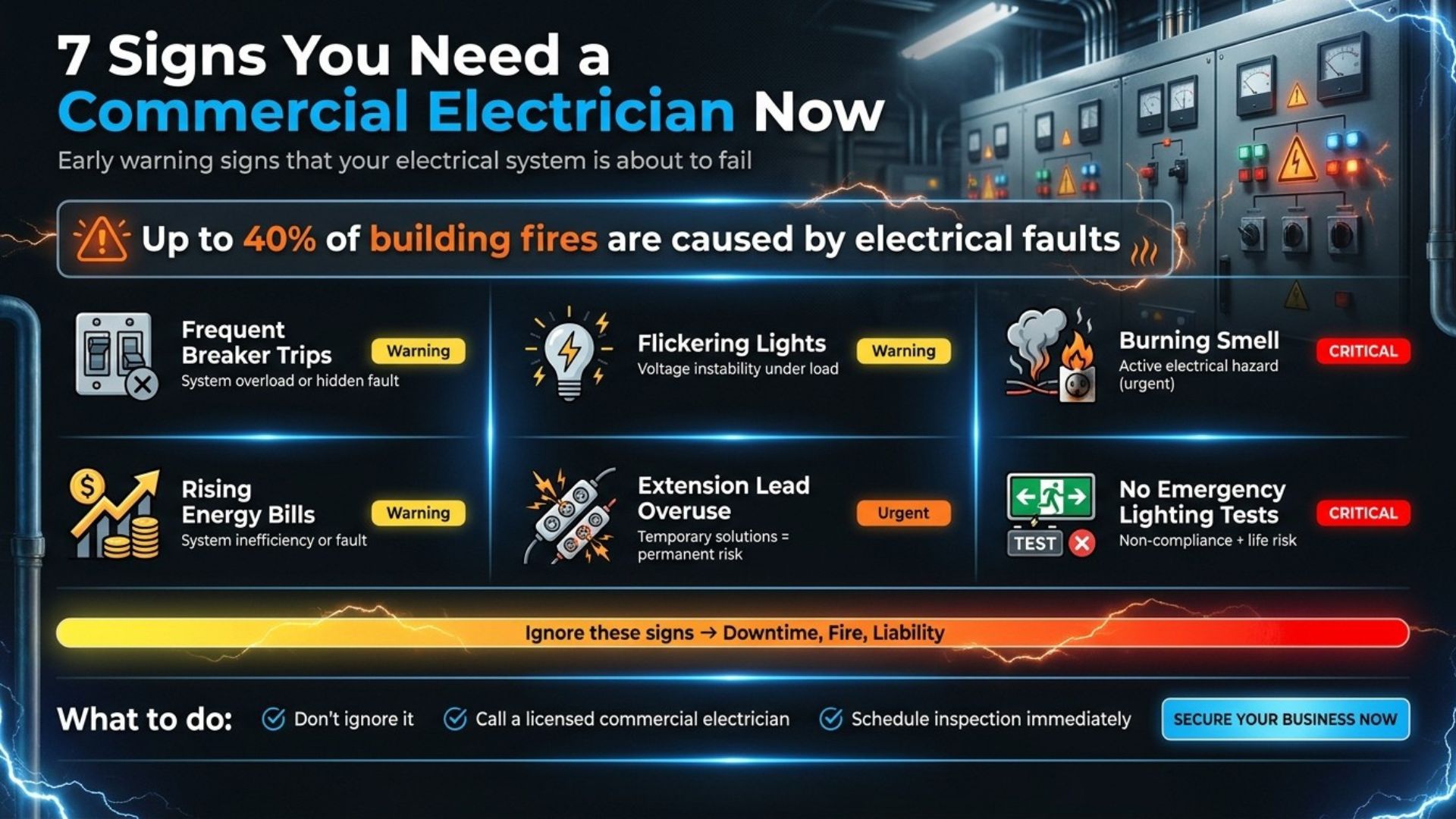
What to Do If You’ve Spotted Any of These Signs
If your business is showing one or more of the signs above, here is the correct sequence of actions — not next month, now.
Step-by-step response:
1. Don’t ignore it and don’t self-diagnose. Electrical faults in commercial premises are not a job for your maintenance person or a handy staff member. Only a licensed commercial electrician can legally diagnose and repair electrical faults in NSW.
2. For burning smells, sparking outlets, or hot switchboards: Treat as emergency. Turn off the affected circuit or the main switch if safe to do so. Call 000 if there is smoke. Otherwise, call Lightspeed Electrical immediately: 1300 968 551.
3. For recurring breaker trips, flickering, or unexplained bill increases: Schedule a fault-finding inspection within 2 weeks. Don’t wait for the situation to escalate.
4. For extension lead reliance or emergency lighting gaps: These are compliance issues with a clear fix. Get a quote for a proper solution.
5. Document the issue before the commercial electrician arrives: Note when it started, how often it occurs, and which parts of the building are affected. This speeds up the fault-finding process.
Why Sydney Businesses Choose Lightspeed Electrical
Lightspeed Electrical has been operating in Sydney since 2013, founded by Alex Schepis — a second-generation commercial electrician with over 20 years of commercial and industrial electrical experience.
Direct quote from Alex Schepis, Founder:
“I’ve seen the consequences of ignored electrical faults in commercial buildings. A burning smell that ‘comes and goes’. A breaker that trips every few weeks. A switchboard that hasn’t been touched since the 1990s. None of these are normal. All of them are fixable — but only if someone calls before the fault becomes a failure.”
Lightspeed Electrical services commercial and industrial clients across Sydney including:
– Australia Post (Strathfield mailing centre fitout)
– University of Notre Dame (library electrical upgrade)
– McDonald Jones Homes (flagship headquarters)
– Little Zak’s Childcare (Blacktown fitout)
– Retail, warehousing, and hospitality clients across the metro area
Services relevant to the warning signs above:
– Electrical fault finding and diagnosis
– Switchboard audits and upgrades (AS/NZS 3000:2018 compliance)
– Emergency lighting installation, testing, and certification (AS/NZS 2293)
– Power point and sub-circuit expansion
– Data and communications cabling
– Full commercial electrical fitouts and maintenance contracts
📞 Call: 1300 968 551
🌐 Web: lightspeedelectricals.com.au
📍 25 Griffiths St, Woolloomooloo, Sydney NSW 2011
🕐 Mon–Fri: 6:00am–5:00pm | Sat: 6:00am–3:00pm
Frequently Asked Questions
How do I know if my Sydney commercial building needs an electrical inspection?
If your building is showing any of the 7 signs covered in this guide — regular breaker tripping, flickering lights, burning smells, warm outlets or switchboards, unexplained energy increases, excessive extension lead use, or lapsed emergency lighting testing — you need an inspection now, not at your next scheduled maintenance date. In NSW, you are legally responsible for ensuring your premises meets AS/NZS 3000:2018 and AS/NZS 2293 requirements.
How often should a commercial building in NSW have an electrical inspection?
There is no single mandated frequency for general electrical inspections in NSW commercial premises, but emergency lighting must be inspected every 6 months and tested annually under AS/NZS 2293. For general electrical systems, most commercial electricians recommend a full inspection every 2–3 years, or sooner if any of the warning signs above are present, if significant new equipment has been added, or if the building is over 20 years old.
Is it illegal to use extension leads as permanent power in a commercial building in NSW?
Yes, in practice. While the regulation is framed through AS/NZS 3000:2018 and WHS obligations rather than a single blanket prohibition, using extension leads as a permanent power source in a commercial setting constitutes a compliance breach and a WHS violation. SafeWork NSW can issue improvement notices or prohibition notices if an inspection reveals unsafe temporary power use.
What is an RCBO and why does it matter for my business?
An RCBO (Residual Current Breaker with Overcurrent protection) combines the function of a circuit breaker and a safety switch (RCD) in a single device. Under AS/NZS 3000:2018, RCD protection is mandatory on commercial circuits. RCBOs trip for a wider range of faults than standard breakers — including earth leakage faults that a conventional breaker would miss. If your switchboard predates 2019 and doesn’t have RCBOs or separate RCDs on circuits, it doesn’t meet current NSW requirements.
What happens if my emergency lighting fails during a fire and someone is injured?
The consequences are severe. Building owners and occupants (depending on lease terms) carry a duty of care under the Work Health and Safety Act 2011 (NSW) and the Environmental Planning and Assessment Regulation. Failure to maintain emergency lighting to AS/NZS 2293 can result in prosecution, fines, and civil liability in the event of injury or death during an emergency. This is not a theoretical risk — it has resulted in prosecutions in NSW.
How quickly can Lightspeed Electrical respond to a commercial electrical fault in Sydney?
Lightspeed Electrical operates Monday to Friday 6:00am–5:00pm and Saturday 6:00am–3:00pm, servicing all Sydney metropolitan areas. For urgent fault situations, call 1300 968 551 directly and describe the nature of the fault. Priority scheduling is available for active electrical faults, safety hazards, and compliance-critical situations.
Can I get a fixed-price quote for a switchboard audit and upgrade?
Yes. Lightspeed Electrical provides free, itemised quotes for switchboard audits, upgrades, and compliance work. Contact them at lightspeedelectricals.com.au/contact or call 1300 968 551.
What does a commercial electrical fault-finding inspection involve?
A licensed commercial electrician will conduct a visual and diagnostic inspection of your switchboard, wiring, outlets, and connected equipment; test RCDs and circuit breakers for correct operation; inspect for signs of heat damage, arcing, or deterioration; and identify any AS/NZS 3000:2018 compliance gaps. You’ll receive a written report with findings and recommended remediation, prioritised by urgency.
AUTHOR BIO
Alex Schepis is the founder and principal commercial electrician of Lightspeed Electrical, Sydney’s trusted commercial and industrial electrical contractor. A second-generation commercial electrician with over 20 years of industry experience, Alex established Lightspeed Electrical in 2013. He has delivered multi-million dollar commercial electrical projects across Sydney, including fitouts for Australia Post, the University of Notre Dame, and McDonald Jones Homes. Alex holds NSW Fair Trading licensing and personally oversees all major commercial fault-finding, compliance, and fitout projects.
Lightspeed Electrical PTY LTD
25 Griffiths St, Woolloomooloo, Sydney NSW 2011
Phone: 1300 968 551
Web: lightspeedelectricals.com.au
Mon–Fri: 6:00am–5:00pm | Sat: 6:00am–3:00pm
REFERENCES
1. Fire and Rescue NSW. Common Home Fires — Electrical Appliances and Faults. fire.nsw.gov.au.
2. SafeWork NSW. Electrical Work — Incidents, Injuries and Findings. safework.nsw.gov.au, 2024.
3. SafeWork NSW. Findings Report: Electrical Safety in Construction 2024. safework.nsw.gov.au, January 2026.
4. Standards Australia. AS/NZS 3000:2018 Australian/New Zealand Wiring Rules (consolidated 2024).
5. Standards Australia / Building Commission NSW. AS/NZS 2293 — Emergency Escape Lighting and Exit Signs.
6. Local Commercial Electrician Sydney. 20 Surprising Statistics About Electrical Emergencies in Australia. localelectricianssydney.com.au, 2025.
7. Safe Work Australia. Key Work Health and Safety Statistics Australia 2025. data.safeworkaustralia.gov.au.
8. Global Fire Safety. Ultimate Summer Fire Safety Checklist for Australian Businesses 2025. globalfire.com.au.