
Bottom line upfront: Often, yes. Most electrical work in an occupied Sydney office, shop or warehouse can be done without closing the business. But the circuits being worked on almost always have to be switched off, because NSW law prohibits live electrical work except in narrow circumstances. The real question is which parts of the building can be safely isolated while the rest keeps running.
Business owners usually ask this as a yes-or-no question. Can you do it without shutting us down? The honest answer depends on something most electrician websites never mention: keeping a business open is not the same as keeping every circuit live.
This guide explains how that distinction plays out in practice. It covers when staged work, after-hours work, or a planned shutdown is the right tool, and what we learned running an eight-week fit-out inside an Australia Post facility that never stopped operating.
Can an electrician work while your business stays open?
In most cases, yes. A licensed electrician isolates the circuits supplying the work area, proves them de-energised, and works on them while the rest of the building stays powered. Staff keep working, customers keep coming in, and only the affected zone loses power. What usually can’t happen is working on equipment while it is still live.
That second point is a legal requirement, not caution on our part. SafeWork NSW states that work on energised electrical equipment is prohibited in NSW unless specific exceptions under the WHS Regulation apply. Those exceptions cover narrow situations, such as testing or equipment that must stay on for safety reasons, and they come with additional controls.
So when a contractor says they’ll “work around you”, the useful follow-up is: which circuits will you isolate, and what else do they supply? A good answer to that question is worth more than any promise about hours.
What are the options: staged work, after hours, or a planned shutdown?
There are three practical approaches. Staged work isolates one zone at a time during business hours. After-hours work moves the disruptive parts outside trading hours. A planned shutdown switches off a wider area or the whole site for an agreed window. Most commercial projects use a mix, chosen by what each stage of the work actually requires.
| Approach | Works well for | Limits |
|---|---|---|
| Staged work, one zone isolated | Adding power and data outlets, lighting changes, fit-out of one floor or area at a time | Only works if the zone’s circuits don’t also feed areas that must stay on |
| After-hours or weekend work | Noisy or dusty work, work in customer-facing areas, short isolations of shared circuits | Fewer people on site to confirm what’s affected; can cost more in labour (confirm on your quote) |
| Planned shutdown | Main switchboard replacement, work on supply mains, anything upstream of most of the building | The business genuinely loses power for the window, so it needs notice, sequencing and a reinstatement plan |
After hours is not automatically the answer. Moving work to night or the weekend helps with noise and foot traffic. It does not solve the underlying problem if nobody has confirmed what each circuit supplies. An isolation done at 10pm on the wrong assumption still takes out the server room.
For whole-building work like switchboard upgrades, some shutdown is usually unavoidable. The goal then is to make it short, scheduled and rehearsed, rather than to avoid it.
What happens when the circuits feed more than one area?
This is the problem that decides whether a business can stay open. In older or repeatedly refitted buildings, the circuits supplying one room often also feed other areas, and the switchboard labels don’t always say so. Before anything is isolated, those supplies have to be traced on site and confirmed, not taken from old drawings.
Sydney’s commercial stock includes a lot of buildings that have been fitted out several times over. Each fit-out adds circuits; not every one updates the records. The result is a room that looks self-contained but is fed from two or three directions. Some of those feeds may also supply equipment the business can’t afford to lose.
A real example: the Australia Post kitchen
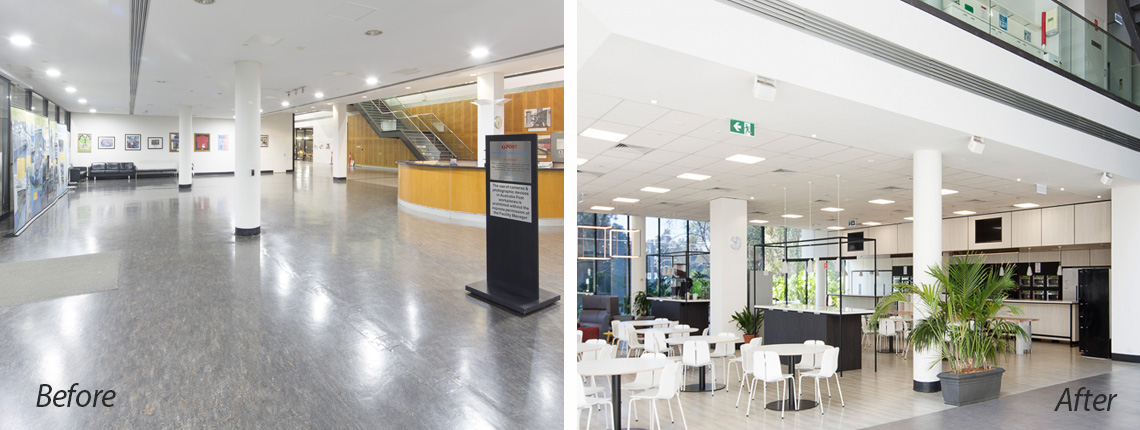
During our fit-out at Australia Post Strathfield, stage two involved stripping out an old staff kitchen. The demolition crew was booked, and we had a 12-hour window to isolate the area and make it safe before they arrived. The kitchen was supplied by multiple circuits coming from different directions across the facility, which kept running around the clock throughout.
So the work wasn’t “switch off the kitchen”. It was:
- Identifying every active cable entering the space.
- Confirming where each one ran and what else it powered.
- Isolating them without cutting supply to the operational areas they shared.
Each step was checked before the next, because the demolition team needed to walk in on schedule with confidence the area was electrically safe.
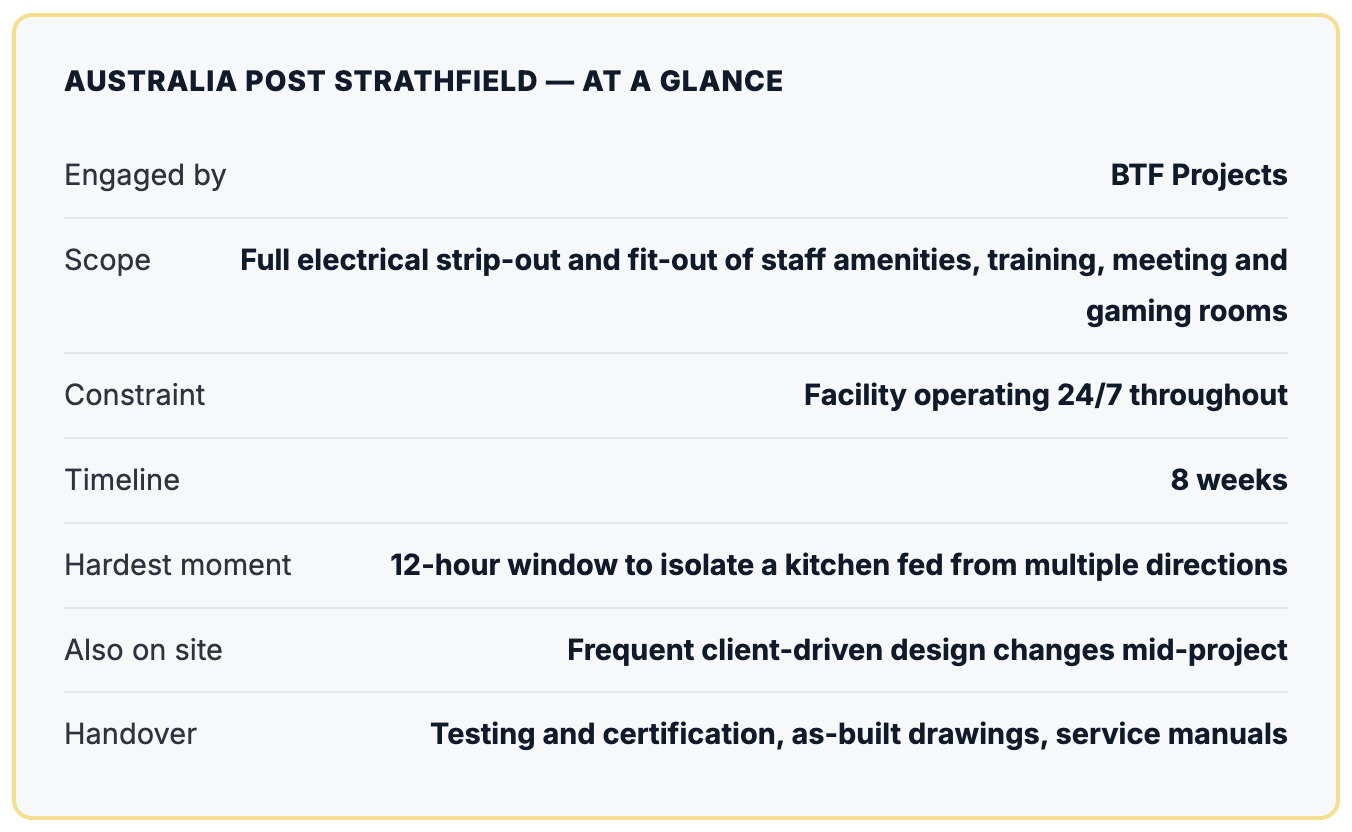
The lesson for any business isn’t that every fit-out can avoid disruption. It’s that the disruption you avoid comes from tracing circuits before the work day, not from working faster on it. Full details are in the Australia Post Strathfield project.
How should a facility manager prepare before the work starts?
List what must stay powered, share any electrical drawings you have, and agree in writing on the isolation boundaries, timing, and who can authorise a shutdown. Then tell affected staff, tenants and IT before the day, not on it. Most disruption comes from surprises, and most surprises are preventable with an hour of planning.
Confirm these before work begins
- What must stay on: servers and comms rooms, refrigeration, security and access control, lifts, medical or safety equipment
- Existing records: switchboard schedules, electrical drawings, previous fit-out documents. Old records still help, even if they’re wrong
- Isolation boundaries: which circuits and areas lose power, in writing
- Timing and authorisation: when each isolation happens, and who on your side signs it off
- Other systems: fire, BMS, security and specialist equipment may need their own maintainers present
- Communication: staff, tenants, IT and building management told in advance
- Contingency: what happens if a circuit turns out to supply something unexpected, or the work runs over
- Reinstatement: time allowed for testing and switching back on, not just the work itself
If a server room or other critical load can’t lose power even briefly, raise it early. Temporary supplies, a generator or the client’s own UPS arrangements may be options to discuss. Lightspeed can arrange temporary power where a site needs it. Each option has to be planned into the sequence, not improvised on the day.
When is a shutdown the safer or more practical answer?
When the work sits upstream of most of the building, when circuits can’t be separated safely, or when trying to keep everything running would stretch a one-day job into two weeks of partial disruption. In those cases, a short, well-planned shutdown costs the business less. Keeping the doors open is a goal; it is never a reason to skip safe isolation.
We’d rather tell you that than sell you an elaborate workaround. Some situations where a planned shutdown is usually the better call:
A planned shutdown usually makes more sense when
- The main switchboard or supply mains are being replaced
- Circuits are so intermixed that partial isolation can’t be proven safe
- Staged work would spread the disruption across many more days
- The area can’t be physically separated from staff or customers during the work
- Another trade’s work (for example, demolition) needs a whole zone dead anyway
And sometimes the job is simply small. Adding two power points in an accessible office doesn’t need a continuity plan. It needs a licensed electrician and twenty minutes of notice to the person whose desk it is.
How does Lightspeed plan electrical work around an operating business?


We start with a site visit to see what the building actually has, not just what the drawings say. From that, we write a scope that names the isolation boundaries, the staging, and any out-of-hours work. You know what goes off, when, and for how long before anything starts. Work finishes with testing and certification.
- Site visit and circuit tracing. We check what supplies the work area and what else those circuits feed.
- Written scope and staging plan. Isolation boundaries, sequence, and any after-hours or shutdown windows, agreed with whoever runs the site.
- Work by zone. Each area is isolated, proven de-energised, worked on, then reinstated. High-impact tasks go into staged shutdowns, nights or weekends, and only when they’ve been scheduled in with you.
- Testing, certification and documentation. Every job in NSW is certified with a Certificate of Compliance for Electrical Work (CCEW). Larger jobs also get as-built drawings and updated switchboard schedules, so the next contractor isn’t guessing.
If cost is the next question on your mind, we cover what moves the price of commercial electrical work in how much a commercial electrician costs in Sydney. That includes what staging and after-hours work does to a quote. If your site mixes offices with warehouse or production space, see commercial vs industrial electricians: what’s actually different.
Ready to plan it? Our commercial electrician team in Sydney starts with a site visit, or you can request a quote online.
Related Services from Lightspeed Electrical
Commercial Electrician
Fit-outs, upgrades and repairs in occupied offices, shops and warehouses.
Electrical Office Fit-outs
Power, lighting and data for a new or refitted workspace, staged around your team.
Industrial Electrician
Work in facilities where production or logistics can’t simply stop.
Electrical Maintenance
Planned maintenance scheduled so it doesn’t become an unplanned outage.
Frequently Asked Questions
Sources & References
- Lightspeed Electricals. (2026a). Australia Post Strathfield project case study. Lightspeed Electricals Commercial Projects.
- Lightspeed Electricals. (2026b). Commercial electrician Sydney: Industrial, retail, and corporate electrical installation and maintenance services. Lightspeed Electricals.
- New South Wales Government. (2026). eCert compliance and electrical safety portal. NSW Housing and Construction Regulation.
- SafeWork NSW. (2024, February 19). Young electrical apprentice injured during commercial wiring work (Incident Information Release No. 3412). SafeWork NSW Compliance and Prosecutions Directorate.
- SafeWork NSW. (2026). Electrical work safety standards, licensing requirements, and risk management guidelines. SafeWork NSW Hazards A–Z.
- Planning approach and field observations reflect Lightspeed Electrical’s own project records

Keep Trading. Isolate the Right Circuits.
We trace what each circuit supplies before anything is switched off, and we’ll tell you honestly when a short planned shutdown is the better option.