Bottom line upfront: In NSW, commercial and industrial electricians hold the same electrical licence. The difference is the work. Commercial work happens in occupied offices, retail, education and fit-outs. Industrial work centres on machinery, heavy three-phase loads and production. Most Sydney projects need some of both, so choose a contractor who can handle every part of your site.
“Commercial” and “industrial” sound like separate trades, and plenty of articles treat them that way. In practice, the line runs through the middle of most real buildings. A warehouse has an office and a lunchroom. A new office fit-out sits in an industrial estate. A logistics site needs high-bay lighting and three-phase equipment on one side and data points on the other.
This guide explains what genuinely differs between the two, where they overlap, what changes on a new build, and how to choose a contractor without paying for the wrong kind of expertise.
Commercial vs Industrial Electrician: Do they need different licences in NSW?
No. The NSW Government requires an electrical licence for any electrical wiring work, regardless of the cost of the work or whether it is residential, commercial, or industrial. “Commercial electrician” and “industrial electrician” describe experience, not licence classes. What you’re really choosing between is the kind of sites a contractor knows well.
Separate credentials do exist for some specific work. Level 2 Accredited Service Providers (ASPs) work on connections to the electricity network, and telecommunications cabling has its own registration. For wiring work inside a building, though, the licence requirement is the same regardless of sector.
One licence, every sector. NSW requires an electrical licence before any electrical wiring work, regardless of cost and regardless of whether the work is residential, commercial or industrial. Source: NSW Government — Electrical licences
Every job, in any sector, also has to be certified. From 1 July 2026, all Certificates of Compliance for Electrical Work (CCEWs) in NSW must be lodged through the Building Commission NSW eCert portal. Handwritten and PDF forms are no longer accepted.
What’s the actual difference between commercial and industrial electrical work?
| What changes | Typical commercial site | Typical industrial site |
|---|---|---|
| Main concern | Keeping staff, customers and tenants working | Keeping machinery and production running |
| Typical work | Office and retail fit-outs, lighting, power and data, emergency and exit lighting, AV and displays | Machinery and equipment connections, motor control and isolators, high-bay lighting, power distribution |
| Supply and loads | Often three-phase, with many smaller loads spread across the floor | Heavy three-phase loads concentrated on equipment |
| Other systems | BMS, lighting control (e.g. C-Bus), access control, data cabling | Control wiring, backup power and UPS, equipment-specific requirements |
| Who you coordinate with | Builder, designer, ceiling and joinery trades, IT | Plant and facility managers, equipment suppliers, mechanical trades |
| Cost of an outage | Lost trading, idle staff, unhappy tenants | Stopped lines, missed dispatches, damaged equipment |
Neither is “harder” in general. An industrial job can be simple: a few new isolators on accessible equipment. A commercial job can be very complex: a whole-floor fit-out with custom lighting, automation and six trades sharing the ceiling.
Where do commercial and industrial work overlap?
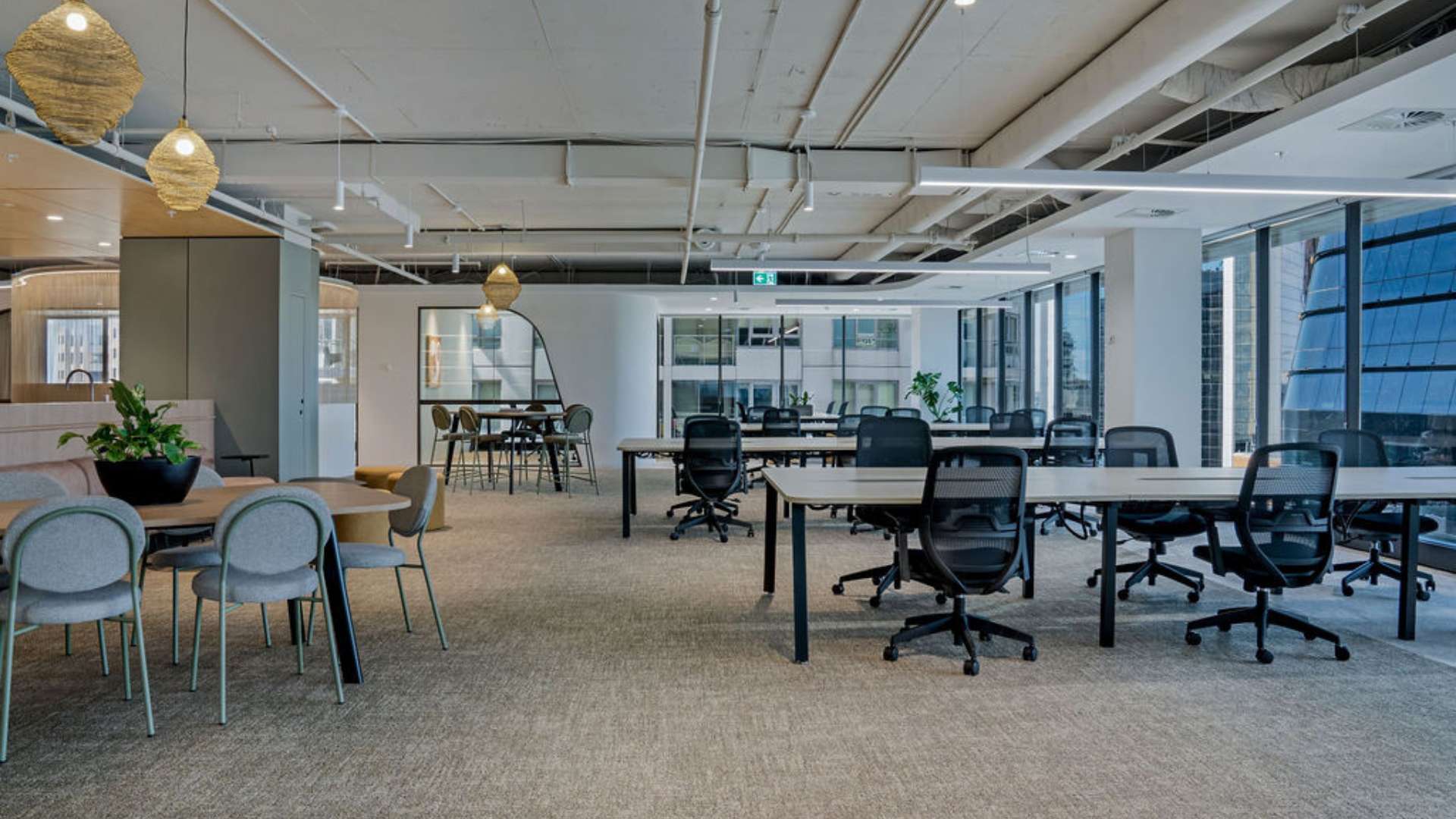
In most warehouses, logistics centres and mixed-use sites. A single project often needs industrial lighting, three-phase circuits and equipment work in one area, and office lighting, power and data in another. If you hire for only one half, the other half becomes a gap someone has to manage, usually you.
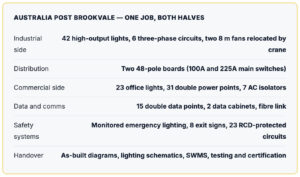
A good example from our own work is a month-long Australia Post fit-out in Brookvale. On the warehouse side, the scope included 42-high-output industrial lights, three-phase circuits, two new distribution boards, and two eight-metre industrial fans. Those fans were dismantled at another Australia Post site in Chullora and relocated with crane assistance. On the office side, the same job covered office lighting, power points, 15 double data points and two data cabinets.
What changes on a new commercial or industrial build?
On a new build, the electrician’s value comes early. Involved at design stage, they can coordinate cable routes, switchboard capacity, lighting and data before walls and ceilings close. Brought in late, they work around decisions already made. The biggest cost and programme risks on new builds come from electrical work planned after the fact.
On new builds and major fit-outs, Lightspeed is often the very first trade on site and the last to leave. That’s because power, data and lighting have to be roughed in before most other trades can finish their work.
Our fit-out at 65 Berry Street, North Sydney, for Gapcomm Projects shows why early involvement matters. We were engaged from the early design phase. The tenancy needed C-Bus lighting scenes by zone, BMS and monitored emergency lighting, plus custom architectural lighting fabricated to follow curved walls, ceilings and feature joinery. Keeping those light lines continuous took precise set-outs coordinated with the joiners and ceiling trades long before anything was switched on. Details are on the 65 Berry Street project page.

On a new build, sort these out with your electrician early
- Switchboard size and spare capacity for future equipment
- Cable routes, risers and ceiling space shared with mechanical and fire services
- Lighting design and controls (scenes, sensors, BMS integration)
- Data and comms rooms, and where displays or AV will go
- Equipment schedules for anything heavy or three-phase
- Emergency and exit lighting, and how it will be tested at handover
Which type of electrician does your project need?
| Your project | What to look for |
|---|---|
| Office fit-out or refurbishment | Commercial fit-out experience: power, data, lighting control and trade coordination |
| Retail, showroom or venue | Commercial lighting plus display and signage infrastructure |
| Childcare, education or healthcare | Commercial experience with occupied, compliance-heavy sites |
| Warehouse or logistics centre | Both: high-bay lighting and three-phase work, plus office and data |
| Factory or production line | Industrial experience matched to your machinery and controls |
| New commercial or industrial build | A contractor who can join at design stage and coordinate with the builder |
| Site that can’t stop operating | Proven experience staging work around live operations |
That last row is where most of the real risk sits, in either sector. We cover it in detail in whether electrical work can be done without shutting down your business, using an Australia Post mail centre that kept running 24/7 through an eight-week fit-out. The full project is on our Australia Post Strathfield page.
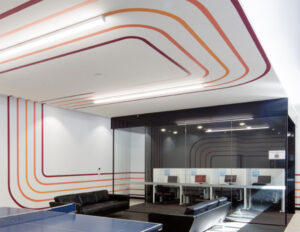
Modern commercial sites also blend power and technology. One contractor who handles power, data cabling and LED and digital displays together removes the gaps between trades.
When are we not the right electrician for the job?
You may be better served elsewhere when
- It’s work on your home. We no longer take on residential jobs.
- It’s a single small repair with no coordination, staging or other trades involved
- Specialised process equipment needs the manufacturer’s own service provider
- The problem is network configuration or software, which belongs with your IT provider
We’re a strong fit when
- It’s an office, retail, education or childcare fit-out
- It’s a warehouse, logistics or industrial site needing power, lighting and equipment work
- It’s a new build and you want the electrician involved from design stage
- The site has to keep operating while the work happens
- Power, data, emergency lighting and displays need to be coordinated together
What should you check before hiring a commercial or industrial electrician?
- Verify the licence on the Service NSW licence check.
- Confirm insurance, and ask for a certificate of currency.
- Ask for comparable projects: a warehouse, a live site, a fit-out of similar size, or a new build.
- Get a written, itemised scope with exclusions and variation rates. We explain how to compare quotes in how much a commercial electrician costs in Sydney.
- Ask about handover: CCEW via eCert, test results, as-built drawings, SWMS and service manuals.
- Check specialist credentials where relevant: Level 2 ASP for network connections, cabling registration for data.
Planning a fit-out, warehouse upgrade or new build? Our commercial electricians in Sydney start with a site visit and a written scope. For production and equipment-heavy sites, see our industrial electrician services, or electrical office fit-outs for office projects.
Related services from Lightspeed Electrical
Commercial Electrician
Fit-outs, upgrades and new builds for offices, retail and education.
Industrial Electrician
Three-phase distribution, machinery connections and production sites.
Electrical Office Fit-outs
Power, lighting and data planned with your builder from the start.
LED & Digital Displays
Video walls and signage installed with the power and data behind them.
Frequently asked questions
In NSW, both hold the same electrical licence. The difference is experience. Commercial electricians mostly work in occupied offices, retail, education and fit-outs, where lighting, data, emergency systems and trade coordination matter most. Industrial electricians focus on machinery connections, motor controls, heavy three-phase loads and production environments. Many Sydney sites, especially warehouses, need both.
Usually one with both commercial and industrial experience. Warehouses typically need high-bay lighting, three-phase circuits and equipment connections in the operational area, plus office lighting, power and data elsewhere. On Lightspeed’s Australia Post fit-out in Brookvale, one scope covered 42 high-output industrial lights, crane-relocated industrial fans, office lighting and 15 double data points.
A commercial electrical contractor with fit-out experience. Office fit-outs involve power and data at workstations, lighting and controls, emergency lighting, and close coordination with the builder, ceiling, joinery and IT trades. Ask for examples of similar fit-outs and a written, itemised scope, and involve the electrician before ceilings close.
As early as the design stage. An electrician involved early can coordinate switchboard capacity, cable routes, lighting design, data rooms and equipment loads before walls and ceilings close. Brought in late, they have to work around decisions already made, which is where most electrical cost and programme overruns on new builds come from.
Yes, if they have experience in both, and it usually works better. One contractor covering warehouse lighting, three-phase equipment, office power and data avoids gaps and finger-pointing between trades. Ask for a comparable project where they handled both halves of a site, and check that the scope covers every area.
Use the Service NSW licence check, which shows the licence type, status and any conditions. Also confirm insurance, ask for references from similar sites, and ask how the work will be certified. From 1 July 2026, every CCEW in NSW must be lodged through the Building Commission NSW eCert portal.
Sources & references
- Lightspeed Electricals. (2026a). 65 Berry Street, North Sydney: Gapcomm Projects electrical installation case study. Lightspeed Electricals Portfolio.
- Lightspeed Electricals. (2026b). Australia Post Brookvale project case study. Lightspeed Electricals Commercial Projects
- Lightspeed Electricals. (2026c). Australia Post Strathfield project case study. Lightspeed Electricals Commercial Projects.
- New South Wales Government. (2026a). Building and trade licences and registrations: Electrical work. NSW Business and Economy.
- New South Wales Government. (2026b). eCert compliance and electrical safety portal. NSW Housing and Construction Regulation.
- Comparisons and field observations reflect Lightspeed Electrical’s own project experience

We’ll look at what your site actually does, from the office to the warehouse floor, and scope every part of it.