Bottom line upfront: In NSW, there’s no separate licence for commercial electrical work. The same electrical licence covers homes, offices and factories. What actually differs is experience: occupied buildings, three-phase loads, shared circuits, documentation and coordination with builders and other trades. Choose based on how complex the job is, not on whether the building is labelled commercial.
When comparing commercial vs residential electrician services, many articles assume commercial electricians have higher qualifications or that hiring a residential electrician for an office creates a compliance risk. In NSW, licensing doesn’t work that way. The more important question is whether the electrician has the right experience for the job.
What could go wrong if the work is poorly planned, and does the electrician you’re hiring have the experience to manage those specific risks?
Commercial vs Residential Electrician: Is there a separate licence in NSW?
No. The NSW Government states that you need an electrical licence before doing any electrical wiring work, regardless of the cost of the work or whether it is residential, commercial, or industrial. A licensed electrician is legally able to work in a home or an office. “Commercial electrician” describes where someone’s experience lies, not a licence class.
There are separate credentials for some specific work. Level 2 Accredited Service Providers (ASPs) work on connections to the electricity network, such as service lines and metering. Data cabling for telecommunications has its own registration. But for wiring work inside a building, the licence requirement is the same across sectors.
Every job, whatever the building, also has to be certified. From 1 July 2026, all Certificates of Compliance for Electrical Work (CCEWs) in NSW must be submitted through the Building Commission NSW eCert portal. Handwritten and PDF forms are no longer accepted. If a contractor isn’t set up for eCert, that tells you something.
One licence, every sector — NSW requires an electrical licence for any electrical wiring work, regardless of cost and regardless of whether the work is residential, commercial or industrial. Source: NSW Government — Electrical licences
So what’s actually different about commercial electrical work?
| What changes | Typical home | Typical commercial site |
|---|---|---|
| Who’s in the building | Household, often flexible about timing | Staff, customers, tenants who need power and access to keep working |
| Supply and loads | Mostly single-phase; three-phase in some homes | Three-phase more common; larger and more varied equipment loads |
| Existing circuits | Usually one switchboard, simpler layout | Multiple boards, years of previous fit-outs, circuits that feed several areas |
| Other systems | Lighting, power, maybe solar or EV charging | Emergency and exit lighting, data and comms, BMS, security, AV, signage |
| Other trades | Often the electrician alone | Builder, ceiling and partition trades, IT, mechanical, fire, all on one programme |
| Paperwork | CCEW | CCEW plus, on larger jobs, safety documentation, as-built drawings, test records and service manuals |
None of this needs a different licence. It needs experience doing it, and a contractor with the people and processes to manage it.
Why is the building label the wrong way to choose an electrician?
Because complexity doesn’t follow the label. Adding two power points in a small shop is simpler than wiring a large automated home. A better test: what happens if this work is poorly planned? If the answer is lost trading, idle staff, delayed trades, or a failed handover, you want commercial experience. If it’s a minor inconvenience, you probably don’t.
Here’s how that plays out across common Sydney jobs:
| Your situation | What to look for |
|---|---|
| Standard home repair or addition | A licensed residential electrician |
| Small, straightforward job in a shop or office | Any licensed electrician with relevant experience |
| Multi-trade office fit-out | A commercial contractor with fit-out coordination experience |
| Retail lighting, signage and display screens | Experience with commercial lighting and display infrastructure |
| Work in a building that can’t close | Experience isolating and staging work in occupied sites |
| Factory machinery or production systems | Industrial experience matched to the equipment |
| Network setup or software issues | An IT provider, with an electrician or registered cabler only for the physical work |
Where does commercial experience actually earn its keep?
In the planning around the wiring. Knowing what else a circuit feeds before isolating it, sequencing work so other trades aren’t waiting, keeping a business trading during the job, and handing over documentation the next contractor can use. Those skills don’t show up on a licence, but they show up in whether the project finishes on time.
A good example from our own work: during a fit-out at Australia Post Strathfield, we had a 12-hour window to make an old kitchen electrically safe before demolition. The kitchen was fed by circuits from several directions, in a facility that operated 24/7. The wiring itself wasn’t unusual. The difficulty was tracing every supply, isolating only what was safe to isolate, and keeping the rest of the site running, inside a fixed window set by another trade.
That’s the part of the job that separates experience levels, and it’s covered in more detail in whether electrical work can be done without shutting down your business. The full project is on our Australia Post Strathfield page.
Modern commercial spaces also blur the line between power and technology. An office fit-out may need power, data cabling, emergency lighting, AV and access control installed in the right place, in the right order, before the ceiling closes. One contractor who can plan across those reduces the gaps between trades.
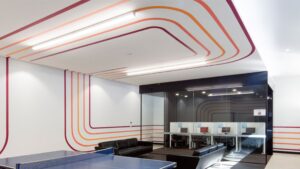
Our fit-out at 65 Berry Street, North Sydney, for Gapcomm Projects is a good example. We were engaged from the early design phase. The tenancy needed C-Bus lighting scenes by zone, BMS and monitored emergency lighting, plus custom architectural lighting that follows curved walls, ceilings and joinery. Keeping those light lines continuous took precise set-outs coordinated with the joiners and ceiling trades. That coordination is the part a licence doesn’t measure. Details are on the 65 Berry Street project page.
When is a residential electrician the right choice?
For most home jobs, and for small, self-contained jobs in commercial premises with no coordination involved. If the work is a standard repair or a few new outlets, a licensed residential electrician is often quicker to book and better suited. Paying for project coordination you don’t need isn’t a good use of your budget.
A residential or general electrician is usually fine when
- It’s a standard domestic repair, addition or upgrade
- The commercial job is small, accessible and self-contained, like a few outlets or replacement fittings
- No other trades, shutdowns or staged access are involved
- The business can easily work around a short interruption
Look for commercial or industrial experience when
- The building has to keep trading while the work happens
- Several trades share the programme and the ceiling space
- Circuits, boards or records are old, shared or unclear
- The scope includes emergency lighting, data, BMS, displays or three-phase equipment
- Machinery or production processes are involved; for those, look for industrial electrician experience
Lightspeed does both, so this isn’t a pitch. If your job is a home one, our residential electrical services page is the right place to start.
What should Sydney businesses check before hiring any electrician?
Check the licence on the Service NSW licence check, confirm insurance, ask for references from similar jobs, and get a written scope that says what’s included and excluded. Then ask how they’ll handle certification, which in NSW now means a CCEW lodged through the eCert portal, and what documentation you’ll receive at handover.
- Verify the licence on the Service NSW licence check. It shows the licence type, status and any conditions.
- Confirm insurance, including public liability, and ask for a certificate of currency for commercial jobs.
- Ask for comparable references, such as a fit-out in an occupied office or work in a 24/7 site, not just “commercial experience”.
- Get a written scope naming quantities, exclusions and how variations are approved. We explain how to compare these in how much a commercial electrician costs in Sydney.
- Ask about certification and handover: CCEW via eCert, test results, and as-built drawings on larger jobs.
- Check specialist credentials where relevant: Level 2 ASP for network connection work, cabling registration for data.
If you’ve worked through that list and your job needs commercial experience, our commercial electricians in Sydney start with a site visit and a written scope. For office projects specifically, see electrical office fit-outs.
Related Services from Lightspeed Electrical
Commercial Electrician
For offices, shops and warehouses where planning and coordination matter.
Residential Electrical Services
For home repairs, upgrades and renovations.
Industrial Electrician
Machinery, three-phase power distribution and production environments.
Data Cabling
Structured cabling planned alongside power, not after it.
Frequently Asked Questions
Yes. The NSW Government requires an electrical licence for any electrical wiring work, regardless of whether it’s residential, commercial or industrial. There is no separate commercial licence for wiring work inside a building. Whether a particular electrician is the right fit depends on their experience with the type of job, not on a licence category.
Not necessarily. If the job is small, accessible and self-contained, such as a few new power points or replacement light fittings, any licensed electrician with relevant experience can do it. Commercial experience starts to matter when the building has to keep trading, several trades are involved, circuits are shared or unclear, or the scope includes data, emergency lighting or three-phase equipment.
Hourly rates can differ, but comparing rates alone is misleading. Commercial quotes often include coordination, staging, after-hours work, documentation and testing that a simple domestic job doesn’t need. The fair comparison is the total cost of the same scope. If your job doesn’t need that coordination, you shouldn’t be paying for it.
Look for industrial experience matched to your equipment: machinery connections, motor controls, three-phase power distribution, and work planned around production. A general commercial electrician may suit lighting and general power in a warehouse. Specialised process equipment may also need the manufacturer’s own service provider.
Many commercial electrical contractors install structured data cabling and the power and mounting for displays, but data cabling for telecommunications generally needs its own cabling registration. Check that the contractor holds it. Network configuration and software issues belong with an IT provider. Planning power and data together during a fit-out avoids reopening ceilings later.
Use the Service NSW licence check, which shows the licence type, status and any conditions. Also confirm public liability insurance, ask for references from similar jobs, and ask how they’ll certify the work. From 1 July 2026, every CCEW in NSW must be lodged through the Building Commission NSW eCert portal.
A Level 2 Accredited Service Provider (ASP) is authorised to work on connections to the electricity network, such as service lines, metering and network connection points. You need one when work touches the supply connection, for example a new or upgraded service to a building. Wiring work inside the building only needs a licensed electrician.
Sources & References
- Lightspeed Electricals. (2026a). 65 Berry Street, North Sydney: Gapcomm Projects
electrical installation case study. Lightspeed Electricals Portfolio. - Lightspeed Electricals. (2026b). Australia Post Strathfield project case study. Lightspeed Electricals Commercial Projects.
- New South Wales Government. (2026a). Building and trade licences and registrations: Electrical work. NSW Business and Economy.
- New South Wales Government. (2026b). eCert compliance and electrical safety portal.
NSW Housing and Construction Regulation. - Service NSW. (2026). Check a builder or tradesperson licence. New South Wales Government
Transaction Portal.
- Comparisons and field observations reflect Lightspeed Electrical’s own project experience

Same Licence. Different Experience.
We’ll look at the job, not the building label, and tell you what kind of electrician it actually needs, even if that isn’t us.