Quick Answer: What Commercial Electrical Energy Upgrades Deliver Payback Under 5 Years in Sydney?
The seven upgrades with the fastest payback in Sydney commercial buildings are: smart sub-metering (1–2 years), LED lighting retrofits (1–3 years), occupancy and daylight sensor controls (1–3 years), variable speed drives on HVAC motors (2–4 years), power factor correction (2–4 years), switchboard load optimisation and tariff realignment (2–4 years), and commercial solar PV (3–5 years). All require a licensed electrician under NSW law. Sequence matters: metering first, then load reduction, then correction, then generation.
- Fastest payback upgrade: Smart sub-metering — identifies 10-20% of energy spend as waste within 90 days, at zero additional capital cost beyond the meter itself
- Most commonly skipped: Power factor correction — invisible on the bill until you know what to look for, but reactive power surcharges silently inflate costs for any building with HVAC compressors or motors
- Most expensive sequencing mistake: Installing solar before completing efficiency upgrades — you end up sizing and funding a generation system for a demand profile that no longer exists after LED and VSD improvements
- Legal requirement: All fixed electrical work — including LED luminaire replacements, VSD installation, sub-metering, and solar — requires a licensed electrician under the NSW Home Building Act 1989 and Electricity (Consumer Safety) Act 2004
- Stat: Australian commercial buildings account for around 25% of national electricity use, with HVAC, lighting, and plug loads representing more than 75% of that draw — meaning the majority of a commercial electricity bill is directly addressable through the upgrades in this guide (DCCEEW, Commercial Buildings Baseline Study 2024)
Sydney commercial electricity prices have increased by more than 30% since 2021. For most facility managers and business owners, the electrical system that was cost-acceptable three years ago is now a significant operating liability, and the gap between what that system costs to run and what a properly upgraded system would cost is growing every quarter.
This guide identifies seven specific commercial electrical energy upgrades that consistently deliver payback under five years in the Sydney commercial context. Every recommendation is grounded in Australian energy benchmarks, current Sydney pricing, and the compliance obligations that constrain what changes you can and cannot make without a licensed electrician.
What most energy upgrade guides don’t tell you: the order of upgrades matters more than the upgrades themselves. Installing solar before fixing your power factor wastes capital. Upgrading to LEDs before adding occupancy controls leaves 25–40% of the available savings on the table. This guide is sequenced deliberately.
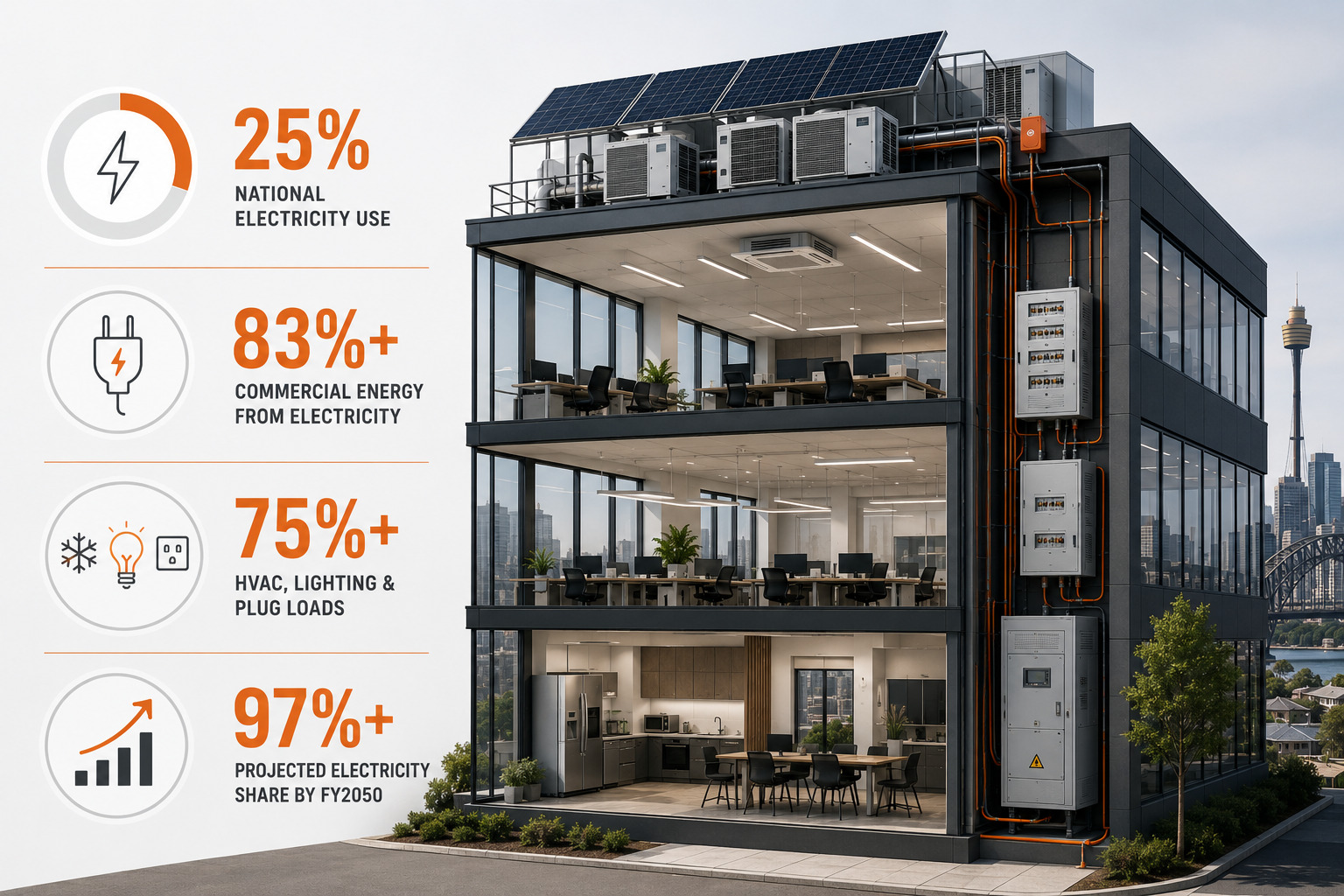
Australian commercial buildings account for around 25% of national electricity use — the single largest sectoral share in the built environment. In FY2023, over 83% of all energy consumed in the commercial sector was electricity, with HVAC, lighting, and plug loads collectively representing more than 75% of that draw. DCCEEW projects the electricity share will rise to over 97% by FY2050 as electrification of gas-dependent equipment accelerates.
Why the Sequence of Electrical Upgrades Determines Your Actual Payback
The order in which you implement commercial electrical energy upgrades directly affects every payback calculation. Measurement must come first (smart metering), then load reduction (LEDs, controls, VSDs), then power quality correction (power factor), then generation (solar). Upgrading out of sequence — installing solar before reducing base load, for example — means you are sizing and funding a generation system for a demand profile that no longer exists after efficiency improvements.
This is the mistake we see most consistently in Sydney commercial buildings that approach energy upgrades without an electrician-led audit. A business installs a 20kW rooftop solar system based on current consumption, then six months later completes an LED retrofit that drops their daytime load by 35%. The solar system is now oversized for actual demand. The payback period lengthens. Feed-in tariff revenue partially compensates — but not fully, and commercial feed-in tariffs in NSW are significantly lower than the avoided consumption rate.
The correct sequence for Sydney commercial premises:
- Measure: Install smart metering and establish a baseline load profile
- Reduce: LED retrofits, occupancy controls, VSD upgrades
- Correct: Power factor correction once the load profile is stabilised
- Optimise: Switchboard load balancing across reduced, corrected load
- Generate: Size solar to the actual post-efficiency demand profile
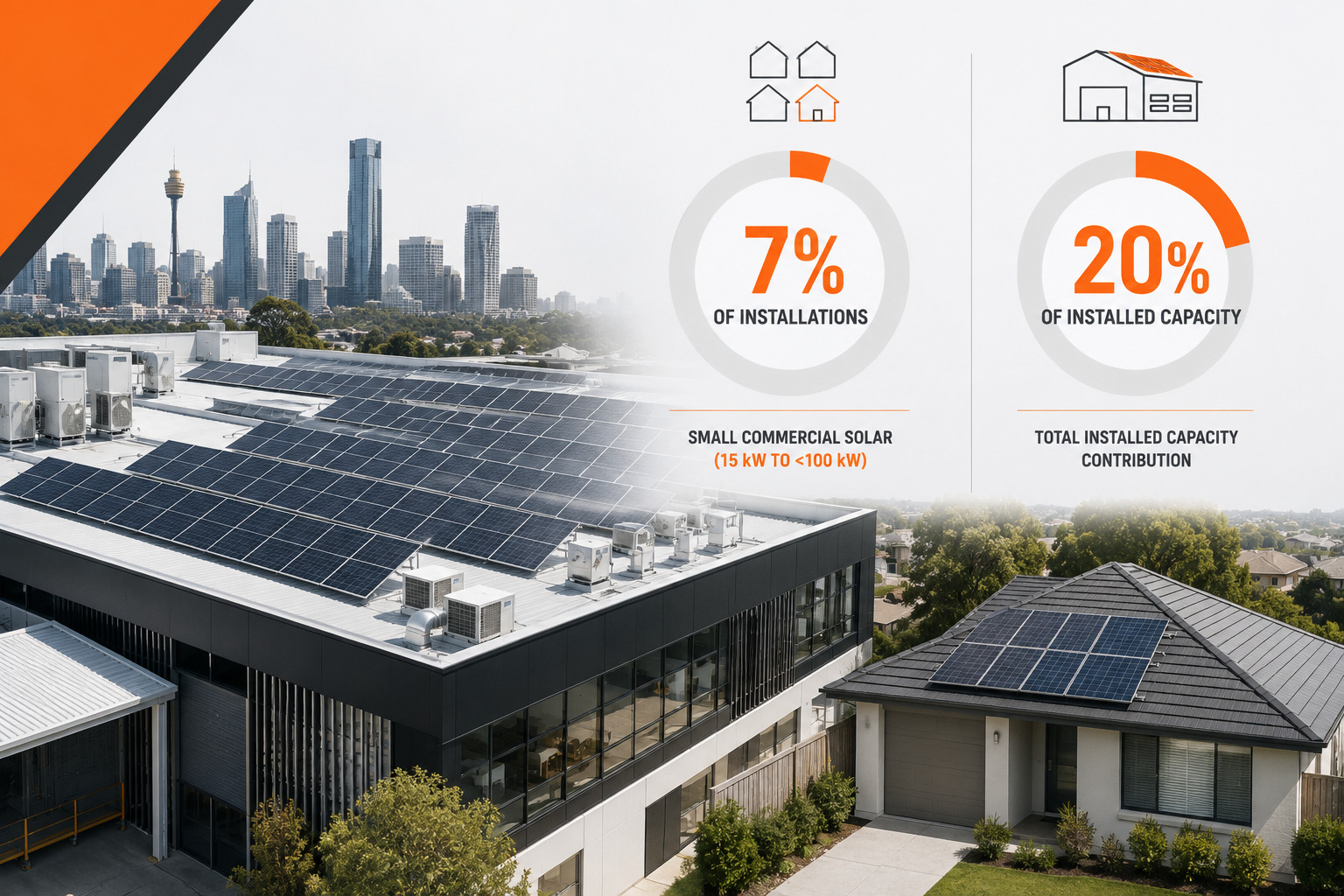
The Clean Energy Regulator’s Quarterly Carbon Market Report (December Quarter 2025) recorded that small commercial solar systems — defined as 15 kW to under 100 kW — represented just 7% of small-scale solar installations nationally in 2024, but contributed 20% of total installed capacity. This disproportionate capacity contribution reflects the higher per-installation system sizes of commercial premises and underscores the significant generation potential of rooftop solar on commercial buildings relative to residential.
Win 1: LED Lighting Retrofits — Payback: 1–3 Years
LED lighting retrofits are the highest-ROI electrical energy upgrade available to Sydney commercial buildings. Replacing T8 fluorescent tubes, halogen downlights, and metal halide high-bays with LED equivalents reduces lighting energy consumption by 50–75%. In a mid-size Sydney commercial office running lights for 60 hours per week, the annual energy saving typically ranges from $3,000–$18,000 depending on floor area, with payback achieved in 12–36 months before any available rebates.
LED retrofits are not a single product — they are a scope decision. The variables that determine your actual payback are luminaire type, hours of operation, current tariff rate, and whether you are doing a straight swap or a full luminaire replacement.
What the Energy Savings Actually Look Like
A typical Sydney commercial office of 500m² with T8 fluorescent lighting running 2,800W of installed load at 10 hours per day, 5 days per week:
- Current annual lighting consumption: approximately 7,280 kWh/year
- Post-LED consumption (at 60% reduction): approximately 2,912 kWh/year
- Annual energy saved: approximately 4,368 kWh
- Annual cost saved (at $0.33/kWh blended rate): approximately $1,441/year for lighting alone
- Retrofit cost (supply and install, T8 tube swap): approximately $3,500–$6,000
- Simple payback: 2.4–4.2 years — improved materially with occupancy controls (Win 2)
For warehouse and industrial premises with metal halide high-bay fittings, the payback is faster. A 400W metal halide replaced by a 150W LED high-bay running 4,000 hours per year saves approximately 1,000 kWh per fitting annually — around $330 per fitting at current rates. A 20-fitting warehouse achieves $6,600/year in lighting savings alone.
What This Requires Under NSW Law
LED tube retrofits in existing T8 luminaires are classified as electrical work in NSW if they involve rewiring the luminaire (bypassing the ballast). This is the most common retrofit method and requires a licensed electrician. Plug-in LED replacements that use the existing ballast do not require a licence — but they deliver lower energy savings and involve ongoing ballast maintenance costs that erode the economics.
A licensed electrician completing a ballast-bypass LED retrofit will also check that the luminaire’s earthing is intact and that the new LED driver is compatible with any existing dimming infrastructure — steps that protect both compliance and performance.
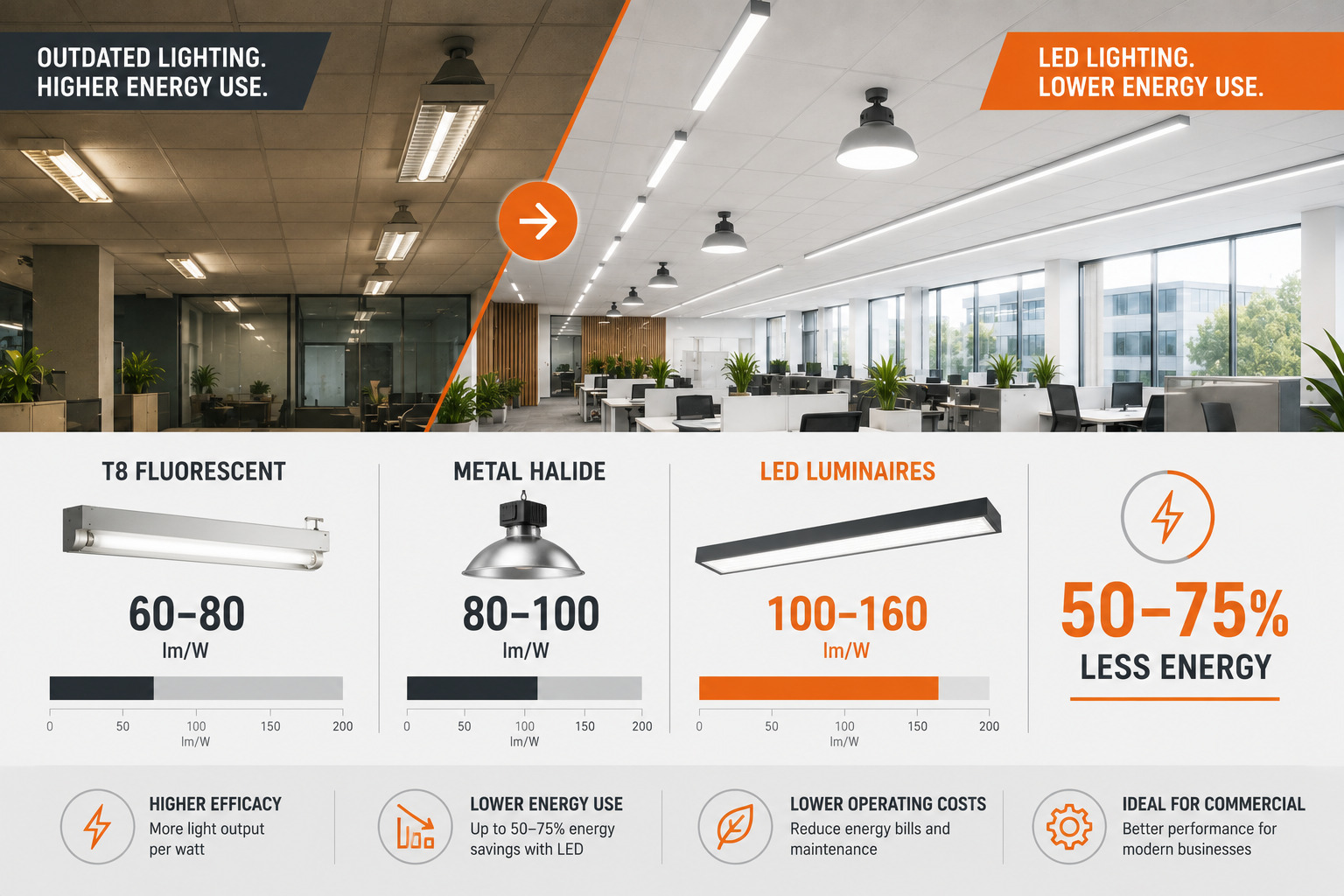
According to the Australian Government’s Energy Rating program and the Illuminating Engineering Society of Australia and New Zealand (IESANZ), commercial LED luminaires now carry efficacy ratings of 100–160 lumens per watt, compared to 60–80 lumens per watt for T8 fluorescent and 80–100 lumens per watt for metal halide. This efficacy gap translates directly to the 50–75% energy reduction that LED retrofits achieve in practice.
Win 2: Occupancy and Daylight Sensor Controls — Payback: 1–3 Years
Occupancy and daylight harvesting controls reduce lighting energy by an additional 25–45% on top of LED savings by ensuring lights operate only when spaces are occupied and dims automatically in daylit areas. In Sydney offices where meeting rooms are empty 60–70% of business hours, motion-controlled lighting is the single fastest-payback add-on to any LED retrofit. Combined with LED, total lighting energy reductions of 70–85% are achievable.
The data on occupancy in commercial buildings is consistently surprising. Independent audits of Sydney CBD office buildings routinely find that 40–60% of lit floor area is unoccupied at any given time during business hours. Open-plan areas near windows receive sufficient daylight for task lighting for an average of 3–4 hours per day. Without controls, lighting runs at full output regardless.
Control Types and Their Applications
| Control Type | Best Application | Typical Energy Saving | Installed Cost (per zone) |
|---|---|---|---|
| Passive infrared (PIR) occupancy sensor | Meeting rooms, bathrooms, storerooms | 30–50% | $80–$200 |
| Ultrasonic occupancy sensor | Spaces with partitions or obstructions | 30–50% | $120–$280 |
| Daylight harvesting sensor | Perimeter offices, atriums, glazed areas | 20–40% | $200–$500 per circuit |
| DALI dimmable driver + scene controller | Open plan, boardrooms, hospitality | 25–45% (combined) | $300–$800 per zone |
The Field Reality: Don’t Install Controls Without LED First
We regularly receive requests to retrofit occupancy controls to existing fluorescent lighting. The technical problem: most T8 fluorescent ballasts cannot dim, and frequent on/off switching reduces tube and ballast life significantly — often shortening the replacement cycle to less than 12 months. The economics collapse.
Occupancy controls are engineered to work with LED drivers. If your building still has fluorescent lighting, the correct sequence is LED retrofit first, then controls — either simultaneously or in immediate succession. Combined procurement also allows the wiring infrastructure to be laid once rather than twice.
Stat: The NABERS (National Australian Built Environment Rating System) Energy Commitment Agreement data for 2024 shows that commercial office buildings achieving a 5-star NABERS Energy rating — the benchmark for operational excellence — consistently record lighting intensity below 4W/m², compared to the 10–15W/m² typical of pre-2015 fluorescent installations. Lighting controls are cited as a key differentiator between 4-star and 5-star performers.
Win 3: Power Factor Correction — Payback: 2–4 Years
Power factor correction (PFC) reduces reactive power drawn from the grid by adding capacitor banks at the switchboard level, improving the ratio of useful (real) power to total apparent power. Sydney commercial premises with inductive loads — HVAC compressors, motors, lifts, and older fluorescent ballasts — typically operate at power factors of 0.75–0.88. Correcting to 0.95–0.99 eliminates the reactive power surcharge applied by your energy retailer and can reduce electricity bills by 5–15% without changing any load behaviour.
Power factor correction is one of the most misunderstood commercial electrical upgrades — and one of the most consistently profitable for premises with significant motor or compressor loads.
How to Know if You Have a Power Factor Problem
Check your electricity bill. Sydney commercial electricity accounts from retailers including AGL, Origin, Energy Australia, and Ausgrid-network resellers include a line item for reactive power or kVAr charges when power factor falls below 0.9 on your metered demand. If that line is present and non-zero, you have a correctable power factor issue.
A simpler indicator: if your building runs three-phase HVAC, commercial refrigeration, industrial motors, or a large lift system, power factor correction almost always delivers a positive ROI. The calculation is straightforward once a licensed electrician measures your actual power factor at the switchboard under load.
What PFC Installation Involves
- Power factor measurement at the main switchboard under representative load conditions
- Capacitor bank sizing calculation (typically 5–50 kVAr for SME commercial premises)
- Automatic power factor correction (APFC) unit installation at the main switchboard
- All work must be performed by a licensed electrician — capacitor banks connect directly to live busbars
- Typical installed cost: $2,000–$8,000 depending on kVAr rating and switchboard configuration
One important caveat: modern variable speed drives (VSDs) — covered in Win 4 — include built-in power factor correction for the motors they control. If you are planning a VSD installation as part of your upgrade program, measure power factor after VSDs are installed before sizing a separate PFC unit, as the VSDs may resolve the problem without additional capacitor banks.
Stat: EnergyAustralia and AGL — two of Australia’s largest commercial electricity retailers — both publish power factor correction as a primary energy cost reduction strategy for commercial and industrial accounts. Installing a power factor correction system that lifts power factor from 0.80 to 0.95 can result in a 79 kVA drop in apparent demand, saving an estimated $7,600 to $11,400 per year at typical Sydney network demand charge rates. Many businesses achieve payback on PFC equipment within two to three years.
Win 4: Variable Speed Drives on HVAC Motors — Payback: 2–4 Years
Variable speed drives (VSDs) — also called variable frequency drives (VFDs) — control motor speed in proportion to actual load demand rather than running at full speed continuously. On commercial HVAC fans, air handling units, pumps, and compressors, VSDs reduce motor energy consumption by 30–60%. The energy saving is non-linear: a motor running at 80% speed uses only about 51% of the energy of the same motor at full speed, due to the cube law relationship between speed and power in centrifugal loads.
VSDs are the highest-impact single upgrade available for commercial buildings with significant HVAC infrastructure. They are also the most frequently deferred — because the upfront cost is higher than lighting upgrades and the savings are less visible than a lighting change. The economics are, however, compelling.
The Cube Law: Why VSDs Outperform Expectations
For centrifugal loads (fans and pumps — the dominant loads in commercial HVAC), the power required follows the cube of the speed ratio:
Power ratio = (Speed₂ / Speed₁)³
Practical examples:
- Running at 90% speed → uses 73% of full-speed power (27% saving)
- Running at 80% speed → uses 51% of full-speed power (49% saving)
- Running at 70% speed → uses 34% of full-speed power (66% saving)
In a Sydney commercial office, HVAC fans rarely need to operate at full speed. Early morning pre-conditioning, partial occupancy periods, and mild weather days — which constitute the majority of operating hours in Sydney’s temperate climate — all represent periods where a VSD-controlled fan can run at 70–85% speed, delivering 15–65% energy savings for those periods.
Typical Installation Scope and Cost
| Motor Application | Typical Motor Size | VSD Installed Cost | Annual Energy Saving | Payback |
|---|---|---|---|---|
| Air handling unit fan | 5–15 kW | $1,800–$5,500 | $800–$3,500 | 1.5–3 years |
| Chilled water pump | 7.5–22 kW | $2,500–$8,000 | $1,200–$5,000 | 2–4 years |
| Cooling tower fan | 2.2–11 kW | $1,200–$4,000 | $500–$2,500 | 2–4 years |
| Exhaust/supply fan | 0.75–7.5 kW | $800–$3,000 | $300–$1,800 | 1.5–3 years |
All VSD installations require a licensed electrician. The drive must be correctly sized to the motor (undersizing causes overheating and premature failure), earthed to the switchboard, and — critically — the motor must be assessed for VSD compatibility. Older motors with standard winding insulation can suffer insulation damage from VSD harmonic output without appropriate filtering. An experienced commercial electrician will assess motor compatibility before sizing the drive.
Stat: HVAC is the largest single electricity end-use in Australian commercial buildings, accounting for approximately 40% of total commercial sector electricity consumption — equivalent to roughly 10% of national electricity use — according to the DCCEEW Commercial Buildings Baseline Study 2024. A peer-reviewed experimental investigation of VSD application to HVAC systems (published in Energy Procedia, ScienceDirect) recorded a global annual energy saving of 38.9% compared to constant-speed HVAC systems operating at equivalent load conditions.
Win 5: Smart Energy Metering and Sub-Metering — Payback: 1–2 Years
Smart energy meters and circuit-level sub-metering provide real-time and interval electricity consumption data for the whole building and individual circuits. Sydney commercial businesses that install sub-metering consistently identify 10–20% of total energy spend as waste within the first 90 days — equipment left on overnight, standby loads that were assumed to be minimal, HVAC running outside occupied hours. The metering pays for itself before the savings from other upgrades are implemented.
Smart metering is not an energy-saving technology in itself — it is a visibility technology. Its payback comes from two sources: direct savings from waste identified and eliminated, and the precision it adds to every other upgrade decision on this list.
What Sub-Metering Reveals That Interval Meters Miss
Your electricity retailer’s smart meter — which records consumption every 30 minutes — tells you how much electricity the building used. Sub-metering tells you where it went. The practical difference:
- After-hours consumption: Sub-metering regularly reveals that 20–40% of commercial energy consumption occurs outside business hours — from servers on standby, HVAC that wasn’t shut down properly, vending machines, display lighting, and chargers left plugged in. This is energy that can be eliminated with controls or scheduling, at zero capital cost.
- HVAC vs. lighting vs. equipment split: Without sub-metering, it is impossible to size a VSD or LED retrofit correctly because you don’t know the actual baseline contribution of each system.
- Demand peaks: 30-minute interval data from a retailer meter can identify demand peaks that trigger demand charges. Sub-metering identifies which equipment is responsible for those peaks and whether load-shifting is feasible.
Metering Options and Costs
| Metering Type | What It Measures | Installed Cost | Best For |
|---|---|---|---|
| Whole-building smart meter upgrade | Total site kWh, kVAr, demand | $300–$800 | All commercial premises |
| Circuit-level sub-metering (4–8 circuits) | HVAC, lighting, equipment separately | $600–$2,000 | SME offices, retail |
| Multi-circuit IoT energy monitoring | Every circuit, real-time dashboard | $2,000–$8,000 | Large commercial, multi-tenancy |
| Power quality analyser (temporary) | Harmonics, power factor, voltage sags | $500–$1,500 (hire) | Pre-upgrade audit |
Stat: The NSW Government’s Metering Strategies for Commercial Buildings guide — published by the NSW Department of Climate Change, Energy, the Environment and Water in August 2025 — identifies after-hours energy waste detection, occupancy-based HVAC and lighting optimisation, and demand peak identification as the three primary financial benefits of commercial sub-metering. The guide notes that interval data from sub-metering enables property managers to benchmark usage across buildings, floors, and tenancy types — providing the evidential base for both operational savings and formal measurement and verification of upgrade outcomes.
Win 6: Switchboard Load Optimisation and Tariff Alignment — Payback: 2–4 Years
Switchboard load optimisation — redistributing electrical loads across circuits, upgrading overcapacity or undersized protection, and aligning the building’s demand profile to a better-matched electricity tariff structure — is one of the least glamorous but most financially material upgrades available to Sydney commercial premises. Tariff misalignment alone can account for 10–20% excess electricity cost on accounts that have never been reviewed against the building’s actual load profile.
Most Sydney commercial buildings are on electricity tariffs that were selected years ago — often by a previous tenant, previous owner, or at the time of building commissioning — and have never been reviewed. Tariff structures change annually. Load profiles change every time a new tenant moves in, new equipment is installed, or operating hours shift.
The Three Areas Where Switchboard Optimisation Saves Money
1. Tariff Renegotiation Based on Actual Load Profile
A licensed electrician with energy management capability can review your current retail electricity contract against your actual 12-month consumption profile (from interval meter data) and identify whether a time-of-use tariff, a flat-rate tariff, or a network-specific tariff structure better matches your pattern. In our experience at Lightspeed Electrical, tariff switches alone save Sydney commercial clients between $800 and $4,000 per year without a single piece of equipment being changed.
2. Demand Charge Reduction Through Load Staggering
Commercial electricity accounts typically include a demand charge based on peak 30-minute consumption during the billing period. A switchboard that allows large loads to start simultaneously — multiple HVAC units, compressors, lifts — creates demand peaks that inflate this charge for the entire month. Installing staggered start timers or demand controllers on switchboard-level circuits can reduce peak demand by 15–25%, directly reducing demand charges.
3. Phase Balancing
Three-phase commercial switchboards that have accumulated unbalanced loads across phases over time suffer from increased neutral current, voltage distortion, and higher apparent power draw. Rebalancing loads across phases is a standard switchboard optimisation task that requires a licensed electrician and delivers immediate reductions in energy waste from neutral heating and transformer losses.
Stat: The Australian Energy Regulator’s (AER) 2025 State of the Energy Market report notes that commercial electricity tariff structures in NSW include network demand charges that can represent 30–45% of a commercial electricity bill for businesses in the 100kVA–1MVA demand range. For these accounts, a 15% reduction in peak demand directly reduces the demand component of the bill by 4.5–6.75% of total electricity cost.
Win 7: Commercial Solar PV — Payback: 3–5 Years
Small-to-mid commercial solar PV systems in Sydney — sized at 10–100 kW — achieve payback periods of 3–5 years under 2026 conditions when installed after efficiency upgrades have stabilised the building’s load profile. Sydney’s average of 4.8–5.2 peak sun hours per day makes it one of Australia’s most productive solar locations. A correctly sized system offsets 30–60% of a commercial building’s annual electricity consumption, with the ROI primarily driven by avoided consumption at $0.28–0.42/kWh rather than feed-in tariff revenue.
Commercial solar is consistently the upgrade that facility managers want to do first — and the one that delivers the best long-term return when done last. The reason is straightforward: solar payback is driven by the avoided electricity cost of self-consumed generation. Every kilowatt-hour the panels generate that the building immediately uses replaces electricity that would have cost $0.28–$0.42/kWh. Every kilowatt-hour that is exported to the grid returns the feed-in tariff — currently $0.06–$0.12/kWh for most NSW commercial accounts.
The economic implication: self-consumption rate determines payback. A system where 90% of generation is self-consumed has dramatically better economics than a system where 40% is exported. Completing efficiency upgrades first reduces total demand — but the reductions happen in baseload, not necessarily in the mid-day solar production window. The correct approach is to model the building’s half-hourly demand profile against the expected solar generation profile before sizing the system.
What a Sydney Commercial Solar System Costs in 2026
| System Size | Typical Installed Cost | Annual Generation (Sydney) | Annual Saving (80% self-use) | Simple Payback |
|---|---|---|---|---|
| 10 kW | $12,000–$17,000 | ~14,000 kWh | ~$3,700 | 3.2–4.6 years |
| 30 kW | $28,000–$40,000 | ~42,000 kWh | ~$11,000 | 2.5–3.6 years |
| 50 kW | $40,000–$58,000 | ~70,000 kWh | ~$18,500 | 2.2–3.1 years |
| 100 kW | $70,000–$95,000 | ~140,000 kWh | ~$37,000 | 1.9–2.6 years |
Note: Savings calculated at $0.33/kWh blended avoided cost for self-consumed generation and $0.08/kWh feed-in for exported generation. STCs (Small-scale Technology Certificates) applied where eligible. Payback does not account for battery storage.
Key Compliance Requirements for Commercial Solar in NSW
- Systems above 100 kW require network connection approval from Ausgrid or Endeavour Energy
- All grid-connected inverters must be CEC (Clean Energy Council) approved and listed on the CEC Approved Inverters list
- Installation must be by a CEC-accredited installer — this is a specific accreditation on top of the NSW electrical licence requirement
- Systems above 30kW require a metering coordinator and Ausgrid network connection agreement
- Structural certification of the roof is required for systems above approximately 15 kW on most commercial buildings
Stat: The Clean Energy Regulator’s December Quarter 2025 report recorded approximately 269,000 new small-scale solar systems totalling 2.8 GW of capacity installed nationally in 2025. By late 2025, Australia had surpassed 4.26 million cumulative small-scale solar PV installations totalling 27.8 GW of rated capacity. Additionally, from 1 October 2026, the Small-scale Renewable Energy Scheme (SRES) eligibility threshold increases from 100 kW to 1 MW — a significant expansion of STC incentive access for larger commercial rooftop solar projects.
Summary: All 7 Upgrades at a Glance
This table summarises the seven commercial electrical energy upgrades covered in this guide, ranked by recommended implementation sequence. Cost ranges reflect Sydney market rates in 2026. Payback periods assume current commercial electricity rates of $0.28–$0.42/kWh and exclude available government rebates or CEFC financing, which can materially shorten each figure.
| Upgrade | Typical Installed Cost | Annual Saving | Simple Payback | Who Can Do It |
|---|---|---|---|---|
| Smart metering / sub-metering | $600–$8,000 | 10–20% of total bill | 1–2 years | Licensed electrician |
| LED lighting retrofit | $3,000–$25,000 | $1,500–$18,000/year | 1–3 years | Licensed electrician |
| Occupancy & daylight controls | $2,000–$15,000 | $800–$8,000/year | 1–3 years | Licensed electrician |
| Variable speed drives (VSDs) | $1,200–$8,000/motor | $500–$5,000/motor | 2–4 years | Licensed electrician |
| Power factor correction | $2,000–$8,000 | $400–$4,000/year | 2–4 years | Licensed electrician |
| Switchboard optimisation / tariff alignment | $500–$5,000 | $800–$6,000/year | 2–4 years | Licensed electrician + energy broker |
| Commercial solar PV | $12,000–$95,000+ | $3,700–$37,000/year | 3–5 years | CEC-accredited licensed electrician |
What Most Energy Upgrade Guides Don’t Tell You
After completing commercial electrical energy upgrades across hundreds of Sydney commercial buildings, the gaps we see in how businesses approach these projects are consistent. They are not technical gaps — they are commercial and procedural gaps that extend payback periods by 1–3 years unnecessarily.
1. The Rebate Landscape Changes Every Quarter — Don’t Anchor to Yesterday’s Numbers
NSW and Commonwealth energy efficiency rebate programs are active, but they change in scope, funding availability, and eligibility criteria regularly. The NSW Energy Savings Scheme (ESS) — administered by the NSW Energy Security Corporation — pays financial incentives (Energy Savings Certificates, or ESCs) for accredited upgrades including LED retrofits and VSD installations. The value of an ESC fluctuates with market conditions. In mid-2026, ESCs are trading at approximately $25–$35 each, and a 500m² commercial LED retrofit may generate 40–80 ESCs — a rebate equivalent of $1,000–$2,800 that directly reduces your payback period.
If a quote you received six months ago did not include ESC-based rebate calculation, get a new quote. The scheme is material at current certificate prices.
2. Your Electricity Contract May Block Your Solar Economics
Some commercial electricity retail contracts include clauses that restrict feed-in tariff access, apply exit fees for contract termination before the end of the term, or require 90-day notice before installation of embedded generation (solar). Before committing to a solar installation, have your retail contract reviewed. We regularly see commercial clients who have signed 3-year supply contracts with retailers that include embedded generation notification clauses — failure to comply can void the contract or attract penalties.
3. Maintenance Contracts That Include Energy Performance Reporting Are Worth a Premium
A commercial electrical maintenance contract that includes quarterly energy performance reporting — comparing actual consumption against the post-upgrade baseline — turns your maintenance spend into an active ROI tracking tool. If a VSD develops a fault and reverts to direct-on-line start, energy consumption on that circuit spikes. If occupancy sensors drift out of calibration, lighting run-hours increase. Without consumption benchmarking built into your maintenance agreement, these degradations are invisible until your next energy bill review.
4. Not All “Energy Audits” Produce Actionable Outputs
A $500 energy audit from a non-electrical consultant typically produces a report. A $800–$2,500 electrical audit from a licensed commercial electrician with calibrated metering equipment produces a report and a scope of works with actual cost and payback calculations tied to your specific building, tariff structure, and load profile. The second one is what generates ROI. The first one generates a document.
Stat: Since its launch in 2009, the NSW Energy Savings Scheme (ESS) has supported projects projected to deliver more than 19,000 gigawatt hours (GWh) of cumulative energy savings, with lighting upgrades — including LED retrofits in commercial and industrial premises — accounting for more than 70% of those savings. The scheme is administered by IPART and the NSW Energy Security Corporation, with Energy Savings Certificates (ESCs) currently tradeable on the NSW electricity market.
How to Choose a Commercial Electrician for Energy Upgrades in Sydney
Not every licensed electrician has the equipment, experience, or accreditations required to deliver commercial energy upgrades correctly. For LED retrofits with ESS rebates, for solar installations, and for VSD work on large motors, specific additional accreditations are required beyond the NSW electrical licence. Engaging the wrong contractor adds cost and may void rebate eligibility.
Verify the following before engaging a contractor for commercial electrical energy upgrades in Sydney:
- Valid NSW electrical licence: Verify at Service NSW licence check portal. Contractor (EC) or supervisor (ES) licence required — a restricted tradesperson (ER) licence cannot supervise work.
- ESS accreditation: For LED and VSD upgrades where you intend to claim NSW Energy Savings Scheme rebates, the installer must be an Accredited Certificate Provider (ACP) or work with one. Ask to see ACP registration before committing — uncertified installations cannot generate ESCs retrospectively.
- CEC accreditation for solar: Required for grid-connected solar installations under the federal Renewable Energy Target scheme. Verify at cleanenergycouncil.org.au.
- Calibrated metering equipment with current calibration certificate: Any contractor performing power factor measurement, VSD sizing, or energy audit work should have calibrated power quality analysers with current certificates. Ask to see the calibration certificate — the date matters.
- Written ROI modelling as part of the proposal: A contractor who cannot produce a site-specific payback calculation before the job starts is not performing energy upgrade work — they are performing standard installation work and applying an energy label to it. The payback period should be calculated against your actual tariff structure, your measured load profile, and your building’s operating hours.
- Public liability insurance of at least $20M: Standard for commercial electrical work. Request the certificate of currency — not just confirmation of insurance.
Frequently Asked Questions
What is the fastest-payback electrical upgrade for a commercial building in Sydney?
LED lighting retrofits combined with smart sub-metering deliver the fastest payback — typically 12–24 months — for most Sydney commercial buildings. LEDs cut lighting energy by 50–75%, and sub-metering identifies additional waste (standby loads, after-hours consumption) that can be eliminated at zero capital cost. Together, these two upgrades typically reduce total electricity bills by 15–30% within the first year.
Do I need a licensed electrician for commercial energy upgrades in NSW?
Yes, for all fixed electrical work. Under the NSW Home Building Act 1989 and the Electricity (Consumer Safety) Act 2004, any work involving fixed wiring — including LED luminaire replacements, VSD installation, power factor correction, sub-metering, switchboard modifications, and solar system installation — must be performed by a licensed electrician. Replacing a light globe or plug-in appliance does not require a licence. Everything else does.
What government rebates are available for commercial electrical upgrades in NSW in 2026?
The NSW Energy Savings Scheme (ESS) pays financial incentives (Energy Savings Certificates, ESCs) for accredited commercial upgrades including LED retrofits, VSD installations, and refrigeration upgrades. ESCs are currently trading at approximately $25–$35 each. A mid-size commercial LED retrofit may generate $1,000–$3,000 in ESC value. At the federal level, the Clean Energy Finance Corporation (CEFC) provides low-interest financing for commercial energy efficiency projects above $500,000. The federal Energy Efficiency Grants for SMEs program (where available) provides direct grants for eligible equipment. Rebate availability changes — verify current programs at energy.nsw.gov.au before budgeting.
How long does commercial solar take to pay back in Sydney?
A correctly sized and sequenced commercial solar PV system in Sydney achieves payback in 3–5 years under 2026 conditions. Larger systems (50–100 kW+) achieve payback closer to 2–3 years due to economies of scale in installation cost. Payback is primarily determined by self-consumption rate — the proportion of solar generation consumed directly by the building rather than exported. Systems where self-consumption exceeds 80% consistently achieve the sub-4-year payback target. Systems installed before efficiency upgrades are completed often have lower self-consumption rates and longer payback periods.
What is power factor correction and does my Sydney commercial building need it?
Power factor correction (PFC) improves the ratio of useful electrical power to total power drawn from the grid, reducing reactive power charges on your electricity bill. Sydney commercial buildings with HVAC compressors, pumps, motors, or lift systems typically have power factors of 0.75–0.88, which triggers reactive power surcharges from the network. A licensed electrician can measure your actual power factor at the switchboard under load and calculate whether PFC delivers a positive ROI. For premises with significant motor loads, it almost always does — with payback of 2–4 years in most cases.
What is a variable speed drive and why does it save energy on HVAC?
A variable speed drive (VSD) controls the rotational speed of an electric motor in proportion to actual load demand, rather than running it at full speed continuously. Because the power consumed by centrifugal loads (fans and pumps) follows the cube of the speed ratio, a motor running at 80% speed uses only about 51% of the energy of the same motor at full speed. In commercial HVAC systems, where fans rarely need to operate at full capacity outside peak conditions, VSDs deliver 30–60% energy savings on controlled motors — with payback periods of 2–4 years in most Sydney commercial applications.
How much does a commercial electrical energy audit cost in Sydney?
A basic commercial energy assessment by a licensed electrician with calibrated metering equipment typically costs $500–$1,500 for SME commercial premises in Sydney. A comprehensive audit including power quality analysis, circuit-level load measurement, tariff review, and written ROI modelling for upgrade options typically costs $800–$2,500. Larger or more complex premises — including multi-tenancy buildings, industrial facilities, or sites with complex HVAC infrastructure — may warrant more extensive audits costing $3,000–$8,000. The audit cost is generally recovered within the first month of implementing identified savings.
What NABERS rating can I achieve with these energy upgrades?
A commercial office building that implements all seven upgrades covered in this guide — metering, LED, controls, VSDs, power factor correction, switchboard optimisation, and solar — can typically achieve a NABERS Energy rating improvement of 1.5–2.5 stars from a pre-upgrade baseline. Starting from 2.5 stars (typical for a mid-2000s Sydney commercial office), a comprehensive upgrade program targeting these seven areas commonly reaches 4.0–5.0 stars, which is the range required for many government tenancy requirements and increasingly demanded by commercial tenants in the Sydney leasing market.
Ready to Calculate the ROI of Electrical Energy Upgrades for Your Sydney Premises?
Lightspeed Electrical delivers licensed commercial electrical energy audits, LED retrofits, VSD installations, power factor correction, and solar project management across Sydney — with site-specific payback modelling, written reports, and ESS rebate management included.
Licensed · Insured · AS/NZS 3000:2018 Compliant · 20+ Years Experience
Call:
Alex Schepis
Founder · Lightspeed Electrical
Alex Schepis founded Lightspeed Electrical to deliver commercial-grade electrical solutions and Level 2 capability with the speed and technical trust large projects require. Drawing on a family legacy in the trade and over two decades of hands-on experience, Alex built Lightspeed around meticulous fit-out execution, rigorous safety compliance, and seamless coordination with builders and project managers. Under his leadership, the Lightspeed team prioritizes on-time delivery and future-ready electrical systems—preferring engineered, long-lasting installations over quick fixes—so commercial clients, developers, and property managers get predictable outcomes on every site.

About Lightspeed Electrical
Sydney’s specialist for commercial fit-outs, multi-complex residential installations, and Level 2 electrical services, offering end-to-end project delivery from design-stage coordination through to final commissioning. Built on a foundation of strict safety standards, licensed Level 2 authority, and consistent workmanship across high-volume fit-outs and supply upgrades.
Office Address: 25 Griffiths St, Woolloomooloo, Sydney NSW 2011
References:
- DCCEEW. (2024). Commercial Buildings Baseline Study — 2024 Update Summary Report. dcceew.gov.au
- NSW DCCEEW. (August 2025). Metering Strategies for Commercial Buildings. energy.nsw.gov.au
- NABERS. (2024). Commercial Office Energy Benchmarks 2024. nabers.gov.au
- Australian Energy Regulator (AER). (2025). State of the Energy Market 2025. aer.gov.au
- Clean Energy Regulator. (2025). Quarterly Carbon Market Report — December Quarter 2025. cer.gov.au
- Clean Energy Regulator. (2025). Small-scale Renewable Energy Scheme — Systems Data. cer.gov.au
- IPART / NSW Energy Security Corporation. Energy Savings Scheme (ESS). energysustainabilityschemes.nsw.gov.au
- EnergyAustralia. Power Factor Correction — Industrial and Commercial Energy Solutions. energyaustralia.com.au
- AGL. Power Factor Correction. agl.com.au
- Pérez-Lombard et al. Variable speed drive technology applied to HVAC systems for energy saving: an experimental investigation. Energy Procedia, ScienceDirect. doi:10.1016/j.egypro.2018.04.059
- Illuminating Engineering Society of Australia and New Zealand (IESANZ). (2025). LED Efficacy and Commercial Lighting Standards. iesanz.org
- Australian Building Codes Board (ABCB). (2024). Commercial Building Energy Efficiency — Cost Impact Regulatory Impact Statement. abcb.gov.au
- NSW Fair Trading. (2024). Electrical Licensing in NSW. fairtrading.nsw.gov.au
- Service NSW. (2024). Check a Builder or Tradesperson Licence. service.nsw.gov.au
- Clean Energy Finance Corporation (CEFC). (2026). Commercial Buildings Electrification Roadmap — Stage One Research Report. cefc.com.au
- Energy Matters. (2025). 2025 Solar, Battery and EV Round Up: Another Record Year. energymatters.com.au