Quick Answer: What Are the Most Common Electrical Issues in Commercial Buildings?
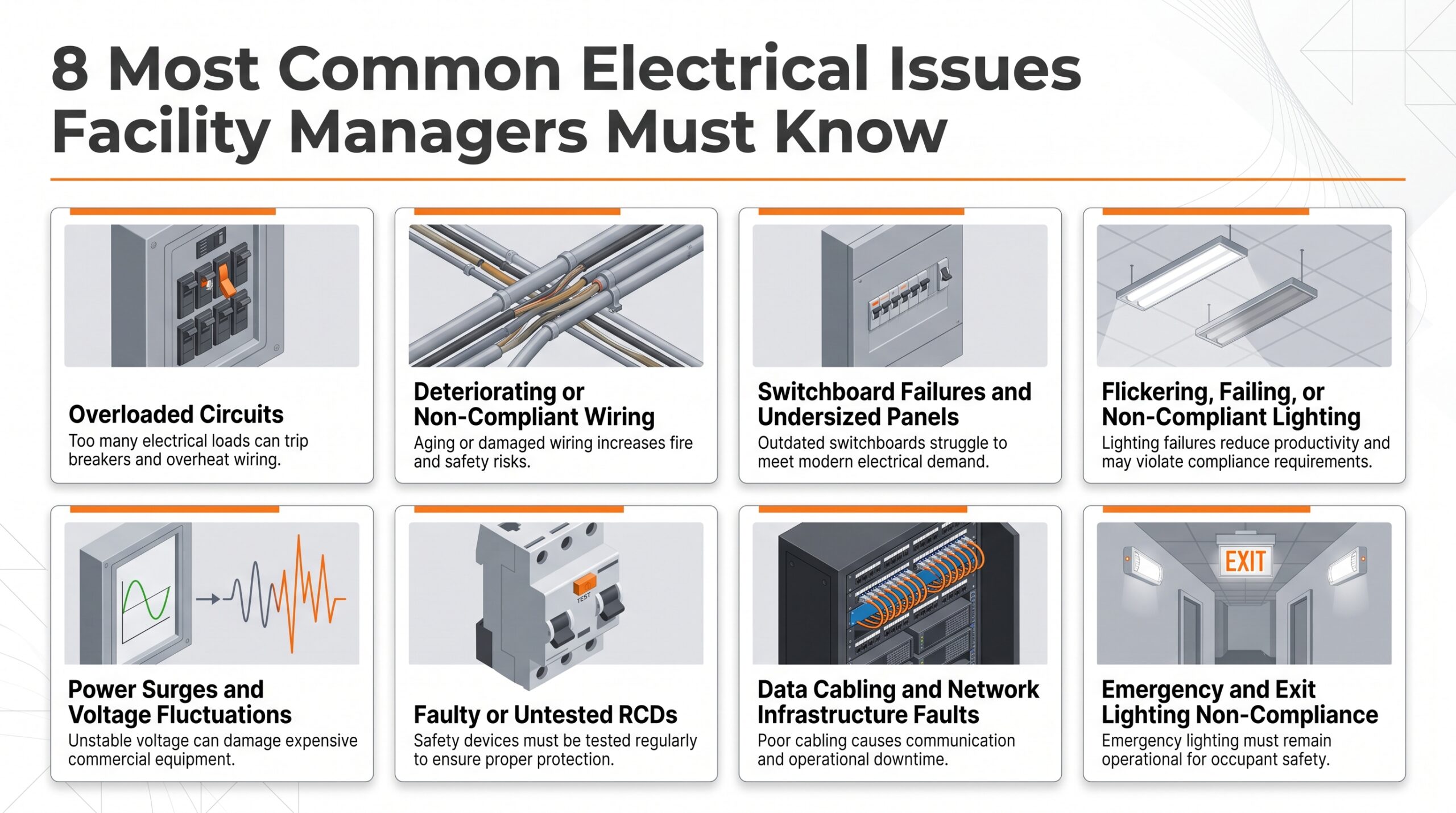
The most common electrical issues in commercial buildings are overloaded circuits, deteriorating or non-compliant wiring, undersized or ageing switchboards, power surges, faulty RCDs (residual current devices), emergency lighting failures, and data cabling faults. Each one carries either a compliance risk, a safety risk, or a direct cost in downtime — often all three at once.
- Most urgent: Faulty RCDs or earth leakage — a direct electrocution and fire risk under AS/NZS 3000
- Most expensive to ignore: Overloaded circuits — a primary electrical ignition source in structure fires across Australia. In 2023, five of sixty workplace fatalities in NSW involved contact with electricity, according to SafeWork NSW.
- Most commonly missed: Emergency and exit lighting non-compliance — often invisible until a WHS audit or insurance claim
- Easiest DIY check: Tripped circuit breakers at the switchboard — but recurring trips always require a licensed electrician
- Average cost of ignoring electrical faults: Unplanned electrical downtime costs Australian organisations with 500+ staff an average of AUD $251,000 per incident — a figure that climbs sharply when fit-out reinstatement and business interruption are included.
Most facility managers assume that electrical problems announce themselves — sparks, dead outlets, tripped breakers. In practice, the faults that cause the most damage in commercial buildings are the ones that run silently for months before they fail. An overloaded distribution board. Wiring that was compliant when installed in 1998, but no longer meets AS/NZS 3000:2018. An RCD that hasn’t been push-button tested in two years.
This guide covers the eight most common electrical issues we see across Sydney commercial buildings — what causes them, what they signal about the broader system health, and the point at which each one moves from a maintenance item to a compliance or safety event.
Issue #1: Overloaded Circuits
An overloaded circuit occurs when the total electrical load connected to a circuit exceeds its rated capacity — typically 10A or 20A in commercial fit-outs. It is the single most common electrical fault we’re called to diagnose in Sydney offices, retail spaces, and warehouses, and the one most often misread as a nuisance rather than a hazard.
The symptom is a tripped circuit breaker. The instinct is to reset it and move on. The problem is that repeated overloading degrades insulation on conductors, generates heat at connection points, and — in worst cases — initiates a wiring fire inside a wall cavity that can smoulder undetected for hours.
What’s causing it in most commercial buildings:
- Fit-out changes that outpaced the original electrical design: Additional workstations, server racks, kitchen equipment, or EV chargers added without updating the circuit load calculations
- Daisy-chained power boards: A common workaround in offices that haven’t had a power audit, and one that bypasses the circuit’s designed protection
- Undersized sub-boards: Original design assumed lower load density than modern equipment demands — particularly relevant in buildings constructed before 2000
- Simultaneous equipment startup: Motor-driven equipment like HVAC compressors or industrial machinery draws 5–7× rated current at startup, briefly spiking past circuit limits
Stat: In 2023, five of sixty recorded workplace fatalities in NSW involved contact with electricity — making it one of the leading causes of work-related deaths in the state. Nationally, Safe Work Australia’s Key Work Health and Safety Statistics 2024 identifies electrical hazards, including overloaded wiring and distribution faults, as a consistent cause of fatal and serious workplace injuries across all industries. AFAC reported approximately 17,000 structure fires across Australia in 2023–24.
Source: SafeWork NSW; Safe Work Australia, Key WHS Statistics 2024; AFAC.
What to do: If a breaker trips once after a clear cause (such as a large appliance starting up), reset it and monitor. If it trips again within days, or if multiple circuits are tripping without an obvious cause, book a load assessment with a licensed commercial electrician. Do not increase the breaker rating to solve a tripping problem — that removes the only protection the circuit has.
Issue #2: Deteriorating or Non-Compliant Wiring
Wiring that was installed to the code standard of its time may now be non-compliant, undersized for current loads, or physically degraded — and in NSW, any new or remedial electrical work must comply with AS/NZS 3000:2018 (the Australian Wiring Rules). Older premises often have wiring that hasn’t been assessed since installation.
The lifespan of PVC-insulated wiring in normal commercial conditions is typically 25–40 years. In high-heat environments (plant rooms, roof spaces, commercial kitchens), UV exposure and temperature cycling accelerate that to 15–20 years. Wiring that’s visibly intact at the termination point may be brittle and cracked inside the conduit.
Warning signs of deteriorating commercial wiring:
- Discolouration or scorch marks around outlets, switchboards, or junction boxes
- A persistent burning smell with no identifiable source
- Outlets that feel warm to the touch under normal load
- Flickering lights that aren’t related to the fitting itself
- Visible sheathing cracks on any accessible wiring runs
Stat: Safe Work Australia identifies electrical hazards — including faulty wiring — as a leading cause of workplace fatalities and serious injuries in the construction and facilities management sectors. In the decade to 2023, electrical incidents accounted for a consistent share of serious injury claims across NSW workplaces.
Source: Safe Work Australia, Work-Related Fatalities Data, 2023.
From the field: in commercial fit-out and renovation projects across Sydney’s inner west and CBD, our team regularly discovers wiring installed in the 1980s and 1990s that uses obsolete conductor sizing or is run without the separation required under current standards. This is especially common in heritage-listed commercial buildings where the structure hasn’t changed hands recently enough to trigger a full electrical audit.
What to do: If your premises are over 20 years old and haven’t had an electrical inspection in the last five years, commission a licensed commercial electrician to carry out a thermal imaging inspection and wiring condition report. In NSW, this is not legally mandatory for existing commercial tenancies on a fixed schedule — but it is required before any renovation or fit-out work, and it’s what your insurer will ask for after an electrical incident.
Issue #3: Switchboard Failures and Undersized Panels
A commercial switchboard is the distribution hub for every circuit in a building. When it’s undersized, outdated, or physically deteriorating, it becomes both a capacity bottleneck and a fire hazard. Switchboard failures are the second most common fault category we attend in commercial call-outs across the Sydney metro area.
Older switchboards — particularly those still using ceramic fuses rather than modern circuit breakers — provide no meaningful overload protection. A ceramic fuse can allow sustained overcurrent that would trip a modern MCB (miniature circuit breaker) in seconds. Porcelain and older Bakelite switchboards also have no provision for RCDs or surge protection, which are now standard requirements under AS/NZS 3000:2018 for new and upgraded installations.
Signs your commercial switchboard needs assessment:
- The board still uses rewireable or ceramic fuses rather than circuit breakers
- There are no RCDs (safety switches) installed on socket-outlet circuits
- The board is physically rusting, discoloured, or emitting a burnt smell
- Breakers trip but immediately reset without tripping again — a sign of thermal drift, not a resolved fault
- The board has no spare capacity for additional circuits — every slot is occupied
Stat: According to NSW Fair Trading, all electrical work in NSW — including switchboard upgrades — must be carried out by a licensed electrician holding a valid electrical contractor or supervisor licence. Unlicensed switchboard work is both an offence under the Home Building Act 1989 and typically voids building insurance for any subsequent electrical incident.
Source: NSW Fair Trading — Electrical Licensing, 2024.
Switchboard upgrade cost context: A commercial switchboard upgrade in Sydney typically ranges from $1,500 to $6,000+ depending on board size, number of circuits, and whether three-phase power is involved. That figure should be benchmarked against the cost of a single electrical incident — which, under the Work Health and Safety Act 2011 (NSW), can include stop-work orders, rectification notices, and court-imposed penalties of up to $500,000 for a corporation found guilty of a Category 3 WHS failure (failure to comply with a WHS duty). Category 2 failures — where the non-compliance exposes workers to risk of death or serious injury — carry penalties up to $1.5 million for corporations.
Source: SafeWork NSW — Work Health and Safety Act 2011 (NSW).
Issue #4: Flickering, Failing, or Non-Compliant Lighting
Persistent flickering or unresponsive lighting in a commercial building is not a globe problem — it’s a wiring, driver, or circuit problem until proven otherwise. In commercial environments, lighting faults also carry compliance implications: under the Work Health and Safety Act 2011 (NSW), employers must provide adequate illumination for safe working conditions.
LED retrofit projects are the most common source of flickering complaints we receive in commercial fit-outs. The issue is almost always driver incompatibility — older dimmer switches and transformer-based circuits are not designed for the low wattage draw of LED fittings, causing visible flicker that ranges from annoying to clinically significant for workers with photosensitive conditions.
Common lighting fault causes in commercial buildings:
- Driver/dimmer incompatibility: Legacy TRIAC dimmers paired with LED downlights — the most frequent call-out in post-LED-retrofit buildings
- Loose terminations: Vibration from foot traffic or HVAC causes terminations at junction boxes to work loose over time
- Neutral conductor faults: A degraded or broken neutral causes voltage fluctuation that presents as flickering across multiple circuits simultaneously
- Overloaded lighting circuits: Adding fixtures to an existing circuit without recalculating the load
- Non-compliant colour temperature or lux levels: AS/NZS 1680 specifies minimum lux levels by task type — open-plan offices require a minimum of 320 lux at the working plane
Stat: Switching to LED lighting in commercial buildings reduces lighting energy consumption by 50–70% compared to fluorescent tube installations, according to the Australian Government’s Department of Energy (DCCEW), Commercial Lighting Guide, 2024. However, poorly executed LED retrofits frequently introduce the driver and compatibility faults described above — undoing efficiency gains through increased fault call-out costs.
Issue #5: Power Surges and Voltage Fluctuations
A power surge is a brief spike in voltage above the standard 230V supplied by the Australian grid. In commercial buildings, surges originate from two sources: externally (lightning, grid switching events) and internally (large motor-driven equipment cycling on and off). Both can damage sensitive electronics — but internal surges are more frequent and more preventable.
The most common internal surge source in commercial buildings is HVAC compressor startup. At the moment a compressor motor starts, it draws 5–7× its rated running current for a fraction of a second. That inrush current causes a brief voltage dip on the shared circuit, followed by a compensatory spike when the motor reaches operating speed. In buildings where HVAC, server rooms, and workstations share distribution, this cycle repeats dozens of times daily.
Signs your building has a surge problem:
- Unexplained failure of IT equipment, particularly at the power supply unit
- LED drivers or control systems failing ahead of their rated lifespan
- Flickering that correlates with HVAC cycling (a specific, identifiable pattern)
- UPS (uninterruptible power supply) units logging frequent surge events
Stat: The Australian Energy Regulator’s 2025 Electricity and Gas Networks Performance Report (December 2025) tracks reliability and outage data across regulated distribution networks nationally. Network operators are required to report voltage quality disturbances — including transient surges caused by switching events — as part of their annual performance submissions to the AER. For commercial tenants, internal surge sources (motor inrush, switchgear switching) compound external grid events and are not captured in distributor-level reporting.
Source: Australian Energy Regulator, 2025 Electricity and Gas Networks Performance Report, aer.gov.au.
Solution: Type 1 and Type 2 surge protection devices (SPDs) installed at the main switchboard, combined with Type 3 point-of-use protection at critical equipment, is the standard recommended approach under AS/NZS 4064 and IEC 62305. This is not a DIY install — SPDs must be correctly rated for the building’s prospective fault current and installed by a licensed electrician to be effective and warranty-valid.
Issue #6: Faulty or Untested RCDs (Residual Current Devices)
An RCD (residual current device, also called a safety switch) is the last line of defence against electrocution. It monitors the current imbalance between active and neutral conductors and trips in as little as 30 milliseconds when it detects a fault current path through a person or to earth. A faulty or untested RCD provides no protection — and in NSW, failure to maintain RCDs is a WHS compliance failure for commercial premises.
The fault mode that makes RCDs dangerous is not dramatic — an RCD doesn’t stop working in an obvious way. It continues to appear functional (the test button still trips it), but the internal mechanism has drifted in sensitivity or response time to the point where it would not trip fast enough in a real fault event. This is only detectable with calibrated RCD testing equipment.
RCD maintenance requirements in commercial buildings (NSW):
- Push-button test: Monthly — can be performed by building staff
- Calibrated trip-time test: Every 12 months — must be performed by a licensed electrician using a calibrated RCD tester
- Documentation: Results must be recorded and kept — required for WHS compliance and insurance purposes
- Replacement trigger: Any RCD that fails a trip-time test, trips spontaneously under normal load, or is over 10 years old should be replaced
Stat: RCDs are effective at preventing electrocution in approximately 70% of electrical shock incidents when correctly installed and maintained, according to research cited by Electrical Safety Foundation International (ESFI). In Australia, Energy Safe Victoria estimates that safety switches prevent hundreds of serious electrical injuries annually.
Source: Energy Safe Victoria — Safety Switches, 2024
From the field: in commercial maintenance contracts across the Sydney CBD and inner suburbs, we consistently find RCDs that haven’t been tested — not because building managers are negligent, but because the testing requirement isn’t well-communicated at lease handover. If your building has changed tenants or had a fit-out in the last three years and you can’t produce RCD test records, those records either don’t exist or weren’t handed over.
Issue #7: Data Cabling and Network Infrastructure Faults
Data cabling faults in commercial buildings are electrical issues — they sit on structured cabling systems that are planned and installed to the same AS/NZS standards as power infrastructure, and they fail for the same reasons: poor termination, physical damage, and fit-outs that weren’t planned around the original cable layout. In modern commercial buildings, a data fault is also a power fault — PoE (Power over Ethernet) cabling carries both.
The most common data cabling fault we resolve in commercial call-outs isn’t a cable failure — it’s a termination failure. RJ45 terminations in patch panels and keystones are crimped or punched down under tension. Over time, vibration, cable movement, and thermal cycling work those connections loose, producing intermittent connectivity that no amount of router rebooting will fix.
Commercial data cabling fault causes:
- Incorrect cable category for the application: Cat5e installed in buildings now running PoE+ switches — the cable may pass a continuity test but fails under the sustained load of PoE devices
- Bend radius violations: Cable routed too tightly around corners or cable tray edges, causing pair deformation and signal degradation
- Cross-talk from power cable proximity: Data and power cables run in parallel without adequate separation — common in older buildings or rushed fit-outs
- Unlabelled or undocumented runs: Legacy cabling with no floor plan documentation, making fault isolation a process of elimination rather than a targeted repair
Stat: Unplanned system downtime costs Australian organisations with more than 500 employees an average of AUD $251,000 per incident, adding up to a potential national cost of AUD $86 billion annually, according to Splunk’s 2025 ANZ Downtime Research Report. For mid-market Australian enterprises specifically, BroadConnect’s 2026 connectivity analysis puts the per-hour cost of an unplanned network outage at AUD $12,500 — with recovery time averaging 7.4 days. A data cabling fault that disables a floor of workstations sits directly in this cost range. Source: Splunk, Downtime: A Rising Challenge for Organisations in Australia & New Zealand, SecurityBrief Australia; BroadConnect, The Real Cost of Business Internet Downtime in Australia
Issue #8: Emergency and Exit Lighting Non-Compliance
Emergency and exit lighting in commercial buildings is not optional equipment — it is a mandatory legal requirement under the Building Code of Australia (BCA/NCC) and must be tested and maintained in accordance with AS/NZS 2293. A commercial premises that cannot demonstrate a current emergency lighting compliance record is non-compliant, regardless of how recently the lights were installed.
This is the most common compliance gap we encounter in pre-purchase or pre-lease electrical audits. Emergency lighting systems fail silently — the battery backup degrades over its 4–6 year cycle, and the fitting continues to look operational under normal power while providing zero illumination in a power failure.
AS/NZS 2293 testing requirements for commercial premises:
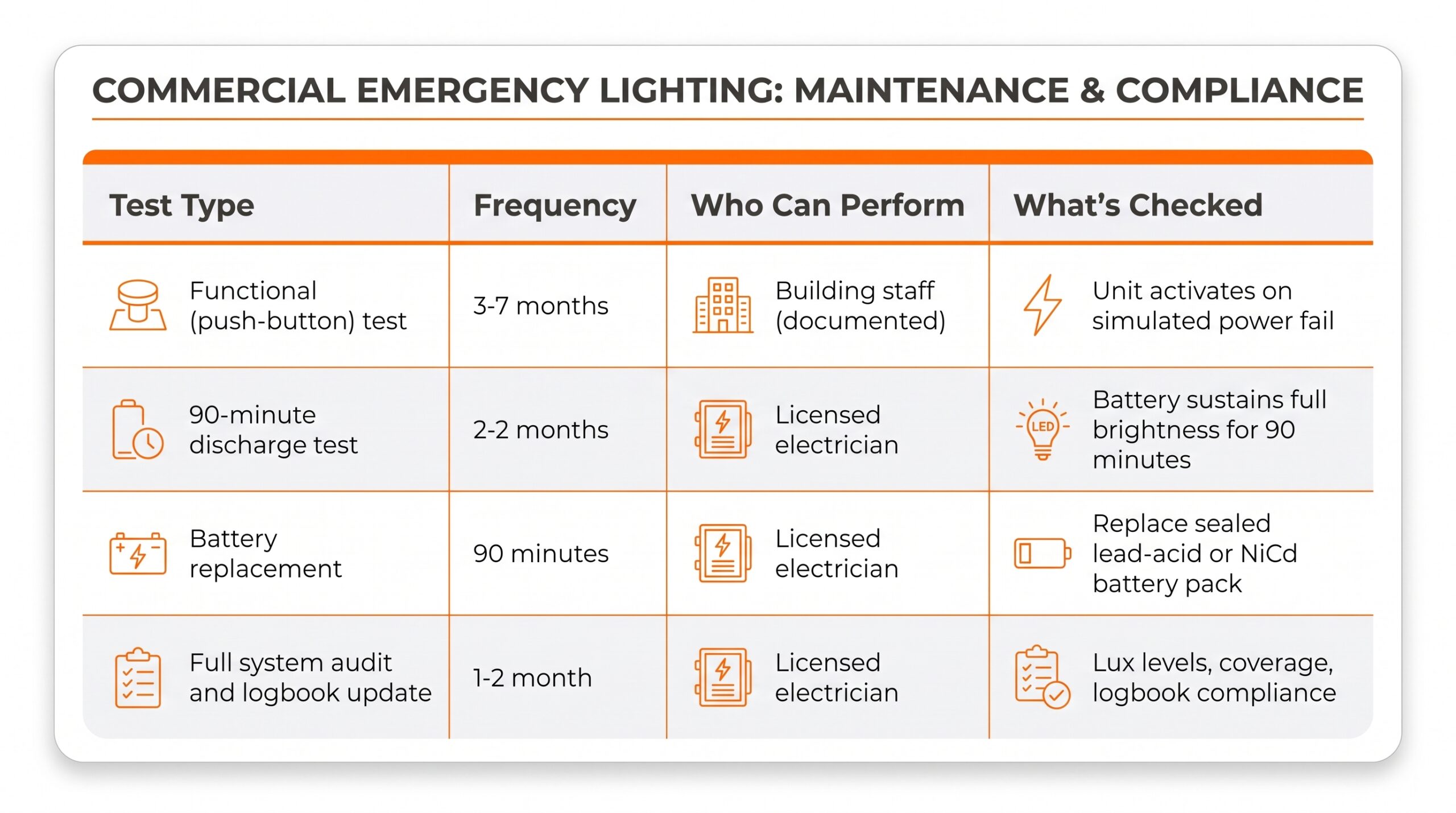
Stat: Under the Work Health and Safety Regulation 2017 (NSW), a person conducting a business or undertaking (PCBU) must ensure emergency plans are maintained and that emergency lighting is functional. Failure during a WHS inspection or incident investigation can result in infringement notices and improvement orders.
Source: SafeWork NSW — WHS Regulation
When to Call a Licensed Commercial Electrician vs. When to Handle It Yourself
In NSW, the legal threshold is clear: any work that involves connecting to or modifying the fixed electrical wiring of a building must be performed by a licensed electrician. That includes changing a light fitting, adding an outlet, or upgrading a switchboard. The only electrical tasks a non-licensed person may legally perform in NSW are replacing light globes, replacing fuses in a fuse holder, and connecting plug-in equipment.
DIY-safe tasks:
- Replacing light globes or LED tubes in accessible fittings
- Monthly push-button testing of RCDs and emergency lights (with documentation)
- Resetting a tripped circuit breaker — once, with monitoring
- Unplugging equipment from overloaded power boards
Always call a licensed electrician for:
- Any recurring circuit breaker trip
- A burning smell anywhere near outlets, switchboards, or cable runs
- Visible scorch marks, discolouration, or warm outlets
- Any electrical fault that correlates with a shock, tingle, or unusual sensation from equipment
- Annual RCD testing, emergency lighting 90-minute discharge tests, or switchboard inspections
- Any new circuit, outlet, or fitting installation
Stat: All electricians in NSW must hold a valid licence issued by NSW Fair Trading. You can verify any electrician’s licence at the Service NSW licence check portal. Hiring an unlicensed electrician voids most commercial building insurance policies for electrical faults and exposes the business owner to personal liability under the Home Building Act 1989.
What a Proper Commercial Electrical Audit Covers
A commercial electrical audit is not a visual inspection of accessible fittings — it’s a systematic assessment of every system that touches your building’s electrical infrastructure. What separates a real audit from a surface-level check is calibrated testing, not just observation.
A complete commercial electrical audit includes:
- Thermal imaging of switchboards, distribution boards, and high-load termination points (identifies hotspots invisible to the naked eye)
- Calibrated RCD trip-time testing on all safety switches with documented results
- Circuit load assessment — actual measured load vs. circuit rated capacity
- Emergency lighting 90-minute discharge test or battery condition assessment
- Wiring condition check including accessible cable runs in plant rooms, roof spaces, and subfloors
- Earth continuity and insulation resistance testing on critical circuits
- Data cabling certification if the premises has structured cabling (Cat5e/Cat6/Cat6A)
- Compliance report against AS/NZS 3000:2018 and relevant NCC provisions
Frequently Asked Questions
What are the most common electrical problems in commercial buildings?
The most common electrical problems in commercial buildings are overloaded circuits, deteriorating or non-compliant wiring, undersized switchboards, faulty RCDs, power surges, emergency lighting compliance failures, flickering lights caused by driver incompatibility, and data cabling faults. Most of these faults are silent until they produce a failure event or a compliance notice.
How do I know if my commercial building’s wiring is up to code in NSW?
The current standard is AS/NZS 3000:2018 (the Australian Wiring Rules). If your building hasn’t had a licensed electrician carry out an inspection in the last five years — or if it was built or last fitted out before 2018 — you should commission a compliance audit. In NSW, any renovation or new electrical work triggers compliance with the current standard, regardless of the age of the existing installation.
How often should RCDs be tested in a commercial building?
Monthly push-button tests should be performed by building staff and documented. An annual calibrated trip-time test must be performed by a licensed electrician using calibrated testing equipment. RCDs that fail a trip-time test or are over 10 years old should be replaced. Records must be kept for WHS compliance and insurance purposes.
What causes circuit breakers to keep tripping in an office building?
Recurring circuit breaker trips in a commercial building are almost always caused by overloading (too many devices on one circuit), a wiring fault (short circuit or earth fault), or a failing breaker itself. Resetting a breaker that trips repeatedly without investigating the cause is dangerous — each trip indicates the circuit reached its protection threshold, which means the connected load or wiring is at risk of overheating.
Is flickering lighting a serious electrical issue in a commercial building?
Yes. Persistent flickering is rarely a globe problem — it indicates a wiring fault, loose termination, neutral conductor issue, or driver/dimmer incompatibility. In commercial settings, it also has WHS implications: AS/NZS 1680 sets minimum illuminance levels for commercial work environments, and inadequate or unstable lighting is a reportable hazard under the Work Health and Safety Act 2011 (NSW).
What does emergency lighting compliance require in NSW?
Under AS/NZS 2293 and the Building Code of Australia, commercial buildings must have emergency and exit lighting that is tested monthly (push-button, by staff), discharged for 90 minutes annually (by a licensed electrician), and have batteries replaced every 4–6 years. Logbooks must be maintained. Failure to comply is a WHS offence and may void building insurance.
How much does it cost to fix common electrical faults in a commercial building in Sydney?
Costs range significantly by fault type. RCD replacement: $150–$400 per unit. Circuit breaker replacement: $100–$300. Switchboard upgrade: $1,500–$6,000+. Wiring fault diagnosis and rectification: $300–$2,000+ depending on access and scope. Emergency lighting compliance audit and repair: $500–$3,000+ for a full commercial floor. The cost of non-compliance — including stop-work orders, penalties, and insurance complications — is consistently higher than the cost of the repair itself.
Can I do my own electrical repairs in a commercial building in NSW?
No. Under NSW law, any work involving fixed electrical wiring — including changing a light fitting, adding an outlet, or modifying a switchboard — must be performed by a licensed electrician. You can legally replace light globes, replace fuses in a fuse holder, and connect plug-in equipment. Everything else requires a licensed contractor. You can verify a licence at the Service NSW licence check portal.
What’s the difference between a safety switch (RCD) and a circuit breaker?
A circuit breaker protects wiring from overcurrent — it trips when too much current flows through a circuit, preventing wiring from overheating. An RCD (safety switch) protects people from electrocution — it trips within 30 milliseconds when it detects current flowing to earth (through a person or a fault). Both are required in commercial buildings. They perform different functions and neither substitutes for the other.
Suspect an Electrical Fault in Your Commercial Building? Don’t Wait for a Failure Event.
Lightspeed Electrical provides licensed commercial electrical inspections, RCD testing, switchboard audits, and emergency lighting compliance services across Sydney — with upfront quotes and no surprise costs.
Licensed · Insured · AS/NZS 3000:2018 Compliant · 20+ Years Experience
Call:
Alex Schepis
Founder · Lightspeed Electrical
Alex Schepis founded Lightspeed Electrical to deliver commercial-grade electrical solutions and Level 2 capability with the speed and technical trust large projects require. Drawing on a family legacy in the trade and over two decades of hands-on experience, Alex built Lightspeed around meticulous fit-out execution, rigorous safety compliance, and seamless coordination with builders and project managers. Under his leadership, the Lightspeed team prioritizes on-time delivery and future-ready electrical systems—preferring engineered, long-lasting installations over quick fixes—so commercial clients, developers, and property managers get predictable outcomes on every site.
About Lightspeed Electrical
Sydney’s specialist for commercial fit-outs, multi-complex residential installations, and Level 2 electrical services, offering end-to-end project delivery from design-stage coordination through to final commissioning. Built on a foundation of strict safety standards, licensed Level 2 authority, and consistent workmanship across high-volume fit-outs and supply upgrades.
Office Address: 25 Griffiths St, Woolloomooloo, Sydney NSW 2011
References:
- Standards Australia. (2018). AS/NZS 3000:2018 — Wiring Rules (Australian/New Zealand Standard for Electrical Installations). standards.org.au
- NSW Fair Trading. (2024). Electrical Licensing in NSW. fairtrading.nsw.gov.au
- Safe Work Australia. (2023). Work-Related Fatalities — Electrical Hazards. safeworkaustralia.gov.au
- SafeWork NSW. (2021). Electrical Risks at the Workplace — Fact Sheet. safework.nsw.gov.au
- SafeWork NSW. (2017). Work Health and Safety Regulation 2017 (NSW). safework.nsw.gov.au
- Energy Safe Victoria. (2024). Safety Switches — Technical Information. esv.vic.gov.au
- Australian Government — Department of Climate Change, Energy, the Environment and Water. (2024). Commercial Lighting Energy Efficiency Guide. energy.gov.au
- Standards Australia. (2005, amended). AS/NZS 2293 — Emergency Escape Lighting and Exit Signs for Buildings. standards.org.au
- Service NSW. (2024). Check a Builder or Tradesperson Licence. service.nsw.gov.au
- Safe Work Australia. (2024). Key Work Health and Safety Statistics Australia 2024. data.safeworkaustralia.gov.au
- SafeWork NSW. Two Too Many Deaths in Two Weeks: A Safety Reminder for Working with Electricity. safework.nsw.gov.au
- SafeWork NSW. Work Health and Safety Act 2011 (NSW) — Penalty Schedule. safework.nsw.gov.au
- Australian Energy Regulator. (December 2025). 2025 Electricity and Gas Networks Performance Report. aer.gov.au
- Splunk / SecurityBrief Australia. (March 2025). Australian Downtime Costs Climb to AUD $86 Billion Annually. securitybrief.com.au
- BroadConnect. (March 2026). The Real Cost of Business Internet Downtime in Australia (2026 Analysis). broadconnect.com.au
- AFAC (Australasian Fire and Emergency Service Authorities Council). (2024). National Structure Fire Data — 2023–24. afac.com.au