Quick Answer: What Should a Commercial Electrical Maintenance Checklist Include?
A commercial electrical maintenance checklist should cover daily visual checks, monthly RCD push-button tests and emergency lighting tests, quarterly switchboard and circuit breaker inspections, and annual calibrated testing of RCDs, thermal imaging of switchboards, and emergency lighting 90-minute discharge tests. All annual testing must be performed by a licensed electrician under AS/NZS 3000:2018.
- Most urgent task: Monthly RCD (safety switch) push-button test — can be done by staff, must be documented
- Most commonly skipped: Annual thermal imaging of switchboards — invisible faults become fires
- Most expensive to miss: Emergency lighting 90-minute discharge test — non-compliance is a WHS offence in NSW
- Legal threshold: Any work on fixed wiring requires a licensed electrician under NSW law
- Stat: Unplanned electrical downtime costs Australian organisations with 500+ staff an average of AUD $251,000 per incident (Splunk, 2025 ANZ Downtime Research Report)
Why Most Commercial Electrical Maintenance Fails Before It Starts
Most facility managers inherit an electrical system they didn’t design, in a building they didn’t build, running equipment that was added without a load audit. The problem isn’t intention — it’s the absence of a structured, frequency-based checklist that maps to the actual compliance obligations under NSW law.
Electrical faults in commercial buildings don’t typically announce themselves. A switchboard running hot for three months looks identical to one that isn’t. An RCD that would fail a calibrated trip-time test looks identical to one that would pass. Emergency lighting batteries that will deliver zero illumination in a power failure look — and test on push-button — exactly like batteries that work.
This guide provides a complete, frequency-structured electrical maintenance checklist for Sydney commercial buildings, grounded in AS/NZS 3000:2018, AS/NZS 2293, and the Work Health and Safety Act 2011 (NSW). Every item maps to a legal or safety obligation, not just a best practice suggestion.
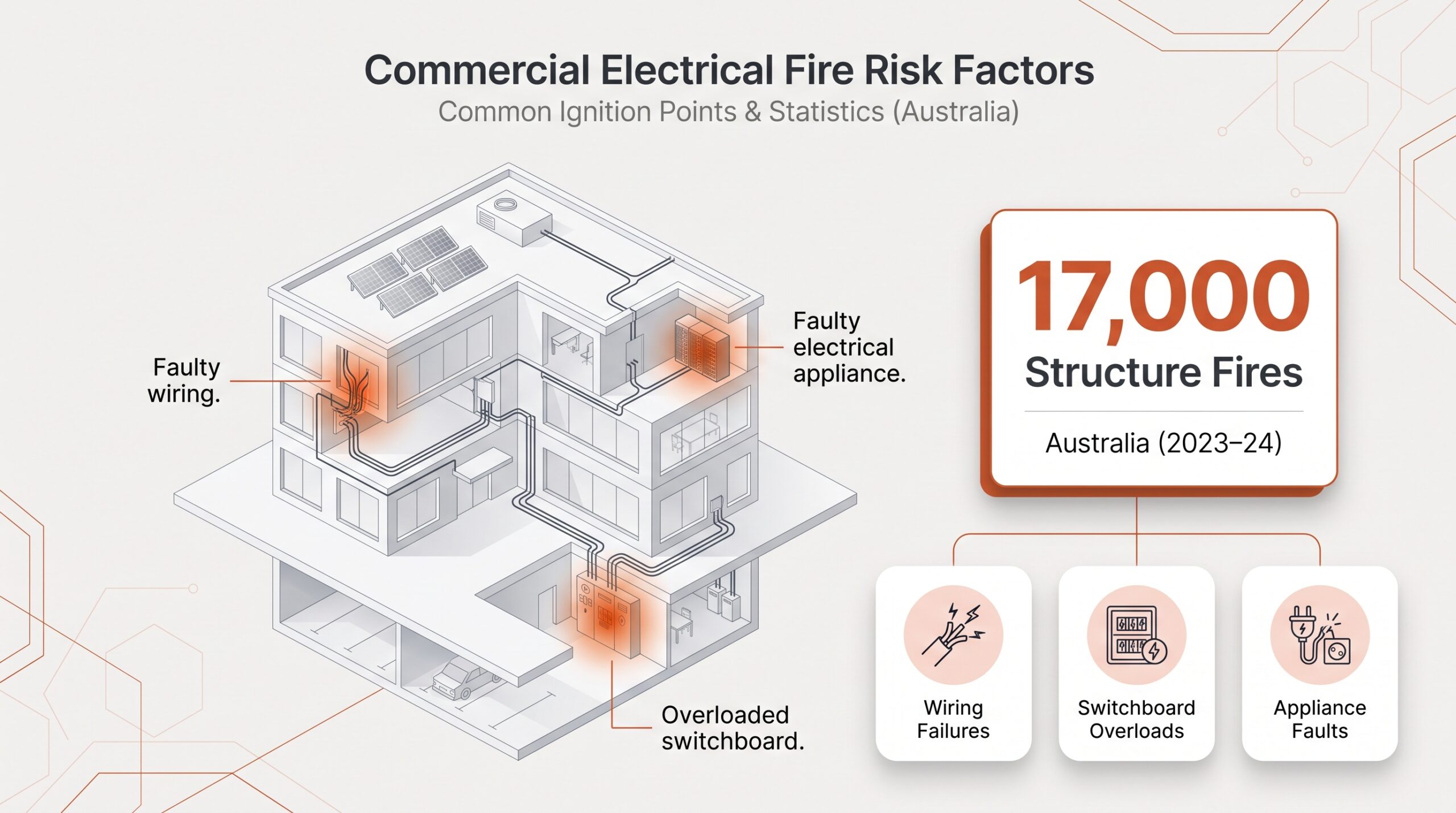
Stat: In 2023–24, approximately 17,000 structure fires were recorded across Australia, according to AFAC (Australasian Fire and Emergency Service Authorities Council). Electrical faults — including wiring failures, switchboard overloads, and appliance faults — are consistently among the leading identified ignition sources in commercial building fires.
Source: AFAC
Who This Checklist Applies To
This checklist applies to any person conducting a business or undertaking (PCBU) in a commercial building in NSW — which under the Work Health and Safety Act 2011 (NSW) includes facility managers, building owners, strata managers, commercial tenants, and property managers. The WHS Act does not distinguish between tenant and owner for the purpose of electrical safety obligations — if you control the premises, you share the duty.
Applicable standards and legislation:
- AS/NZS 3000:2018 — Australian Wiring Rules (the base standard for all electrical installation and maintenance)
- AS/NZS 2293.2:2019 — Emergency Escape Lighting and Exit Signs: Inspection and maintenance
- Work Health and Safety Act 2011 (NSW) — primary duty of care framework
- Work Health and Safety Regulation 2017 (NSW) — specific plant and electrical safety provisions
- NSW Electricity (Consumer Safety) Act 2004 — electrical safety in commercial premises
Stat: Under the Work Health and Safety Act 2011 (NSW), a Category 2 WHS failure — where non-compliance exposes workers to risk of death or serious injury — carries a maximum penalty of AUD $1.5 million for corporations. Category 3 failures carry penalties up to $500,000. Electrical system non-compliance sits squarely within these categories.
Source: SafeWork NSW
The Complete Commercial Electrical Maintenance Checklist (by Frequency)
The following checklist is structured by maintenance interval. Each task is labelled with who can legally perform it: [STAFF] for tasks building staff may complete, and [LICENSED] for tasks that require a licensed electrician under NSW law.
Daily Checks (Visual Only — Staff)
Daily electrical checks are visual inspections, not electrical work. No tools, no panels, no testing equipment. The goal is to identify obvious warning signs before they become fault events.
| Task | What to Look For | Action if Found | Who |
|---|---|---|---|
| Visual check of accessible outlets and switches | Scorch marks, discolouration, cracks, warmth to touch | Isolate the outlet, do not use, call licensed electrician | [STAFF] |
| Check for burning smell near switchboard, outlets, or cable runs | Burnt plastic or ozone smell | Do not investigate further — evacuate if persistent, call licensed electrician | [STAFF] |
| Confirm all emergency exit lighting is illuminated | Any unlit exit signs or emergency fittings | Log and report — book licensed electrician within 24 hours | [STAFF] |
| Observe lighting for persistent flickering | Flickering that correlates with HVAC cycling or occurs across multiple circuits | Log and report — book licensed electrician for diagnosis | [STAFF] |
| Check that power boards are not daisy-chained | Power boards plugged into power boards | Remove the secondary board immediately — replace with a dedicated circuit if needed | [STAFF] |
Monthly Checks
Monthly electrical maintenance tasks include both staff-performed tests and documented inspections. The most critical monthly task — and the one most frequently skipped — is the RCD push-button test. Monthly testing is not optional; it is a compliance requirement for commercial premises in NSW.
| Task | Method | Pass Condition | Who |
|---|---|---|---|
| RCD (safety switch) push-button test | Press the test button on each RCD in the switchboard. Time the trip. | Device trips immediately. Reset by flipping back to ON. Document result and date. | [STAFF] |
| Emergency lighting push-button test | Press the test button on each emergency fitting for 10 seconds | Fitting illuminates from battery backup within 2 seconds. Log in the emergency lighting logbook. | [STAFF] |
| Visual inspection of switchboard exterior | Visual only — do not open panel | No visible rust, scorch marks, discolouration, or burning smell from the board | [STAFF] |
| Check circuit breaker positions | Visual check — are any breakers in tripped position? | All breakers in ON position. Any tripped breaker should be reported — not reset without investigation if it has tripped before. | [STAFF] |
| Power board and extension lead audit | Walk the tenancy — look for overloaded, damaged, or daisy-chained boards | No daisy-chaining, no damaged cords, no boards in high-traffic areas where cords can be walked on | [STAFF] |
Stat: Monthly push-button testing of RCDs is required under AS/NZS 3000:2018 and the WHS Regulation 2017 (NSW). Research cited by Energy Safe Victoria indicates that correctly installed and maintained RCDs prevent electrocution in approximately 70% of electrical shock incidents.
Source: Energy Safe Victoria
Quarterly Checks (Licensed Electrician)
Quarterly electrical maintenance tasks require a licensed electrician and should be performed under a structured maintenance contract. These tasks sit below the threshold of a full annual audit but above what building staff can legally or safely perform. Quarterly checks are particularly important for high-load commercial premises — commercial kitchens, server rooms, manufacturing facilities, and multi-tenancy buildings with shared switchboards.
| Task | What It Involves | Who |
|---|---|---|
| Switchboard internal visual inspection | Licensed electrician opens and inspects the board interior — busbar condition, breaker seating, signs of arcing, heat discolouration, pest ingress | [LICENSED] |
| Circuit load spot-check on high-draw circuits | Clamp meter reading on circuits serving HVAC, kitchen equipment, server rooms — compare to rated capacity | [LICENSED] |
| Tighten and re-torque switchboard terminations | Thermal cycling causes termination screws to work loose — re-torquing is the single most effective preventive task for switchboard fires | [LICENSED] |
| Data cabling patch panel inspection | Visual inspection of RJ45 terminations at patch panels — look for loose, pulled, or damaged connections | [LICENSED] or structured cabling contractor |
| Outdoor and carpark lighting check | Check all external fittings for water ingress, insect damage, and cable condition — external fittings degrade faster than internal ones | [LICENSED] |
Annual Checks (Licensed Electrician — Mandatory)
Annual electrical maintenance is the compliance backbone of your building’s electrical safety program. Several of these tasks are legally required under NSW law, not merely recommended. A licensed electrician must perform all of them, and the results must be documented and retained, because in a WHS audit or insurance claim, undocumented maintenance is treated as maintenance that didn’t happen.
| Task | Standard / Requirement | Pass/Fail Threshold | Who |
|---|---|---|---|
| Calibrated RCD trip-time test | AS/NZS 3000:2018 / WHS Reg 2017 | Trip time ≤300ms at rated trip current (30mA). Fail = replace the unit. | [LICENSED] |
| Emergency lighting 90-minute discharge test | AS/NZS 2293.2:2019 | Each fitting must maintain rated lux output for 90 minutes from battery. Fail = replace battery or fitting. | [LICENSED] |
| Thermal imaging of switchboards and distribution boards | AS/NZS 3000:2018 (best practice, triggered by AS/NZS 3190) | No hotspot more than 10°C above ambient for equivalent conductors. Any hotspot requires investigation and rectification. | [LICENSED] with thermal imaging equipment |
| Insulation resistance testing on critical circuits | AS/NZS 3000:2018 | ≥1 MΩ between conductors and earth at 500V DC for circuits up to 500V. Lower readings indicate wiring degradation. | [LICENSED] |
| Earth continuity testing | AS/NZS 3000:2018 | Continuity confirmed between all protective earth conductors and the main earthing terminal | [LICENSED] |
| Full circuit load assessment | AS/NZS 3000:2018 Clause 2.2 | Actual measured load on each circuit does not exceed 80% of circuit rated capacity under sustained load conditions | [LICENSED] |
| Structured data cabling certification (if applicable) | AS/NZS 11801 | All runs pass channel performance test for category rating (Cat5e, Cat6, Cat6A). Fail = re-terminate or replace run. | [Licensed cabling contractor] |
| AS/NZS 3000:2018 compliance report | AS/NZS 3000:2018 | Written report identifying any non-compliances, with recommended rectification and timeline | [LICENSED] |
Stat: The NSW Work Health and Safety Regulation 2017 requires PCBUs to ensure that electrical equipment used in the workplace is inspected and tested by a competent person, with the testing interval determined by risk. For fixed electrical installations in commercial buildings, industry standard practice — consistent with AS/NZS 3000:2018 — is annual inspection and testing by a licensed electrician.
Source: SafeWork NSW
Five-Yearly Checks (Full Electrical Audit)
Every five years — or at lease change, after significant fit-out, or after a reportable electrical incident — a full commercial electrical audit is warranted. This goes beyond maintenance and into compliance verification across the entire installation.
- Full wiring condition inspection including plant rooms, roof spaces, and subfloor runs
- Emergency lighting battery replacement (4–6 year cycle per AS/NZS 2293)
- Switchboard age and capacity assessment — boards over 20 years old should be evaluated for replacement
- Earthing system integrity test, including main earth electrode resistance measurement
- Surge protection device (SPD) condition check — SPDs have a finite lifespan and may have absorbed surge events without visible failure
- Full AS/NZS 3000:2018 gap analysis against current standard, especially relevant if the building was last inspected under a prior edition
What Most Electrical Maintenance Checklists Don’t Tell You
After two decades performing commercial electrical maintenance across Sydney, the gaps we see most consistently aren’t in the technical tasks — they’re in the documentation and frequency decisions that sit around them.
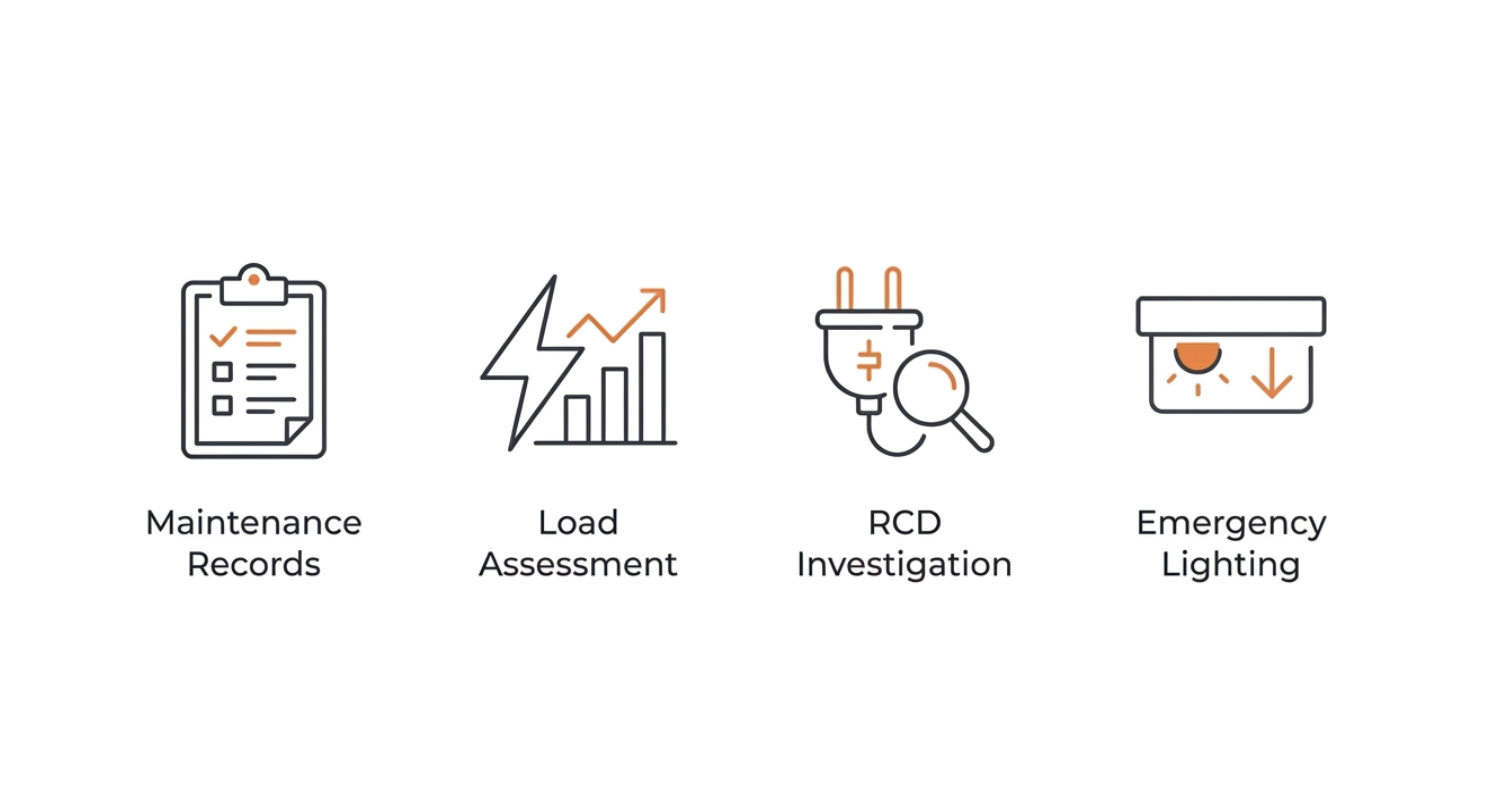
Here are four things that standard checklists omit:
1. “Passed push-button” is not a maintenance record
Logging “RCD tested — OK” without recording the date, which device, who tested it, and whether documentation was retained is not a compliant maintenance record. In a WHS audit or insurance investigation, undated logs provide no protection. Every test entry needs: date, device identifier (RCD 1, RCD 2, etc.), result, tester name, and next test due date.
2. Fit-out changes reset the maintenance baseline
When a commercial tenancy is refitted — new workstations, new kitchen equipment, new server infrastructure, additional lighting circuits — the electrical load profile of the building changes, often substantially. The existing maintenance schedule was calibrated to the previous load. A post-fit-out circuit load assessment should be mandatory, not optional. We regularly find circuits running at 90–100% of rated capacity after a fit-out that added equipment without a parallel electrical upgrade.
3. RCD trip events are data, not nuisances
Every spontaneous RCD trip is a recorded event indicating that a fault current path to earth existed — through a piece of equipment, through deteriorating wiring insulation, or through water ingress. Most facility managers reset the RCD, note that “it hasn’t tripped again,” and move on. The correct response is to identify the cause before restoring power to the circuit. A licensed electrician can perform insulation resistance testing on the circuit’s connected equipment within an hour of the trip event, while the fault signature is still present.
4. Emergency lighting logbooks disappear at lease handover
AS/NZS 2293 requires a logbook to be maintained for each emergency and exit lighting installation. In practice, logbooks are maintained by the outgoing tenant or their contractor — and are frequently not handed over to incoming tenants or new facility managers. If you have taken over management of a commercial premises and cannot locate the emergency lighting logbook, treat the system as untested and commission a licensed electrician to perform a full 90-minute discharge test and start a new log. The cost is $500–$3,000 depending on floor size. The cost of non-compliance during a WHS audit is higher.
Stat: According to Safe Work Australia’s Key Work Health and Safety Statistics Australia 2024, electrical hazards account for a consistent share of serious injury claims across NSW workplaces annually. The sectors with the highest electrical incident rates include construction, manufacturing, and commercial facilities management — where fixed electrical installations are in continuous use.
Source: Safe Work Australia
What You Can Do Yourself vs. What Requires a Licensed Electrician in NSW
In NSW, the legal boundary for electrical work is set by the Home Building Act 1989 and the Electricity (Consumer Safety) Act 2004. The threshold is fixed wiring: any task that involves connecting to, modifying, or testing the fixed electrical wiring of a building must be performed by a licensed electrician. This is not a guideline — it is a criminal offence to perform licensed electrical work without a licence in NSW.
| Task | Staff Can Do | Licensed Electrician Required |
|---|---|---|
| Replace a light globe or LED tube in an accessible fitting | ✓ | |
| Monthly RCD push-button test (and document results) | ✓ | |
| Monthly emergency lighting push-button test (and log results) | ✓ | |
| Reset a tripped circuit breaker — once, with monitoring | ✓ (once only) | Required if it trips again |
| Unplug equipment from an overloaded power board | ✓ | |
| Replace a fuse in a removable fuse holder | ✓ | |
| Change a light fitting or downlight | ✓ | |
| Add or relocate a power outlet | ✓ | |
| Calibrated RCD trip-time testing | ✓ | |
| Emergency lighting 90-minute discharge test | ✓ | |
| Open a switchboard panel for any purpose other than reading labels | ✓ | |
| Thermal imaging of switchboards | ✓ (with thermal imaging equipment) | |
| Any work on data cabling that terminates at a patch panel or outlet | ✓ or licensed cabling contractor | |
| Switchboard upgrade or circuit addition | ✓ |
Stat: All electricians in NSW must hold a valid licence issued by NSW Fair Trading. You can verify any electrician’s licence at the Service NSW licence check portal: service.nsw.gov.au. Engaging an unlicensed electrician voids most commercial building insurance policies and exposes the business owner to personal liability.
Source: NSW Fair Trading
Cost of Commercial Electrical Maintenance in Sydney (2026 Benchmarks)
Cost transparency is one of the most consistent gaps we see in how facility managers budget for electrical compliance. The following benchmarks are based on Lightspeed Electrical’s commercial maintenance pricing in the Sydney metro area as of 2026. All figures are indicative — scope, access, and building age affect final cost.
| Service | Typical Cost Range (Sydney, 2026) | Frequency |
|---|---|---|
| Annual RCD calibrated trip-time testing (per device) | $80 – $150 | Annual |
| Emergency lighting 90-minute discharge test (per floor) | $300 – $800 | Annual |
| Switchboard thermal imaging and report | $400 – $1,200 | Annual |
| Full commercial electrical maintenance audit (SME premises) | $800 – $2,500 | Annual |
| Switchboard upgrade (standard commercial, 3-phase) | $1,500 – $6,000+ | As required (every 15–25 years) |
| Emergency lighting battery replacement (per fitting) | $80 – $200 | Every 4–6 years |
| Circuit load assessment (full tenancy) | $500 – $1,500 | After fit-out changes |
| Ongoing commercial maintenance contract (monthly/quarterly visits) | $300 – $900/month | Ongoing |
The consistent finding across our maintenance contracts: facilities that invest in a structured annual maintenance program spend less per year than facilities that respond reactively. A reactive call-out for a switchboard fault during business hours in Sydney typically costs $800–$2,000 before any rectification work begins — a figure that often exceeds the cost of a full annual maintenance contract.
Stat: Unplanned system downtime costs Australian organisations with more than 500 employees an average of AUD $251,000 per incident. For mid-market Australian businesses, the per-hour cost of an unplanned electrical or network outage averages AUD $12,500, with recovery time averaging 7.4 days.
Source: Splunk, Downtime, BroadConnect
How to Choose a Commercial Electrician for Electrical Maintenance in Sydney
Not every licensed electrician is the right fit for commercial maintenance. A residential electrician who occasionally takes commercial call-outs is not the same as a commercial electrician with a structured maintenance program, calibrated testing equipment, and familiarity with AS/NZS 2293 emergency lighting standards.
Here is what to verify before engaging a commercial electrician for an ongoing maintenance contract:
- Valid NSW electrical licence: Verify at Service NSW. A contractor licence (EC) or supervisor licence (ES) is required — a restricted tradesperson licence (ER) is not sufficient for supervisory work.
- Public liability insurance of at least $20M: Standard for commercial electrical work. Ask for the certificate of currency — not just confirmation that they’re insured.
- Calibrated RCD testing equipment: Calibrated test equipment should have a current calibration certificate. Ask to see it — an electrician performing RCD trip-time tests with uncalibrated equipment is producing results you cannot rely on in a WHS audit.
- Emergency lighting logbook management: Your maintenance contractor should maintain and retain your AS/NZS 2293 logbook, not hand it back to you to file. Loss of records is your liability, not theirs.
- Structured maintenance report output: After every visit, you should receive a written report that includes: tasks performed, results, any defects identified, recommended rectification timeline, and confirmation of compliance against applicable standards. A verbal debrief is not a maintenance record.
- Experience with buildings of your type and age: A heritage-listed commercial building in the Sydney CBD requires different experience than a new warehouse in Parramatta. Ask for examples of comparable premises in their maintenance portfolio.
Stat: According to NSW Fair Trading (2024), all electrical work in NSW must be carried out by a licensed electrician holding a valid electrical contractor or supervisor licence. Unlicensed electrical work is an offence under the Home Building Act 1989 and typically voids building insurance for any subsequent electrical incident.
Source: NSW Fair Trading
Situational Triggers: When to Book an Unscheduled Electrical Inspection
A frequency-based checklist assumes normal operating conditions. The following events should trigger an unscheduled licensed inspection regardless of where you are in your maintenance calendar.
Book a licensed inspection immediately if:
- Any RCD trips spontaneously under normal load (not caused by a known appliance fault)
- A burning smell is detected near any switchboard, outlet, junction box, or cable run
- Any person receives a shock or tingling sensation from equipment connected to the building’s electrical system
- Scorch marks, discolouration, or melting is visible on any outlet, fitting, or switchboard surface
- A circuit breaker trips and immediately trips again on reset — do not reset a third time
- A lightning strike or severe storm event occurred on or near the premises
- Water ingress into a switchboard, light fitting, or any area with electrical infrastructure
Book a licensed inspection within 30 days if:
- You have completed a fit-out, renovation, or equipment installation that changed the electrical load profile of any area
- You have taken over management of a premises with no maintenance records or records older than 12 months
- You cannot locate the emergency lighting logbook
- Any circuit is regularly tripping (more than once per quarter) without an identified cause
- Your switchboard uses rewireable (ceramic) fuses rather than circuit breakers
- The building is over 20 years old and has not had a formal electrical inspection in the past five years
Stat: In 2023, five of sixty recorded workplace fatalities in NSW involved contact with electricity — making electrical contact one of the leading causes of work-related deaths in the state. SafeWork NSW notes that many electrical fatalities involve equipment or installations that had shown warning signs prior to the incident.
Source: SafeWork NS
What a Commercial Electrical Maintenance Audit Covers: The Full Scope
A commercial electrical maintenance audit is not a visual walkthrough. It is a systematic, calibrated assessment of every system that carries electrical risk in your building. The following scope is what Lightspeed Electrical delivers as a standard commercial audit — it is also what your insurer and SafeWork NSW expect to see documented if a reportable incident occurs.
- Thermal imaging of all switchboards, distribution boards, and high-load connection points
- Calibrated RCD trip-time testing on all safety switches, with documented pass/fail results per device
- Insulation resistance testing on critical circuits — comparison of current reading against baseline trend
- Earth continuity testing across the main earthing system
- Full circuit load measurement — actual measured load vs. rated capacity, with flagging of circuits above 80%
- Emergency lighting 90-minute discharge test or battery condition assessment — with logbook entries
- Wiring condition check across accessible runs in plant rooms, roof voids, and subfloors
- Switchboard termination inspection and re-torque
- Structured data cabling certification if Cat5e, Cat6, or Cat6A infrastructure is present
- Written compliance report against AS/NZS 3000:2018 and relevant NCC provisions
- Defect register with prioritised rectification timeline — immediate, within 30 days, within 12 months
Stat: The Australian Energy Regulator’s 2025 Electricity and Gas Networks Performance Report tracks voltage quality disturbances and network reliability nationally. For commercial tenants, internal surge sources — motor inrush, switchgear switching, HVAC compressor startup — compound external grid events and are not captured in distributor-level reporting. Switchboard surge protection devices are the primary mitigation and should be assessed as part of any annual electrical audit.
Source: Australian Energy Regulator
Frequently Asked Questions
What is a commercial electrical maintenance checklist?
A commercial electrical maintenance checklist is a structured, frequency-based schedule of electrical safety and compliance tasks for commercial buildings. It covers daily visual checks, monthly RCD and emergency lighting push-button tests, quarterly switchboard inspections, and annual calibrated testing — all mapped to the legal obligations of facility managers and building owners under NSW law and AS/NZS 3000:2018.
How often does commercial electrical maintenance need to be done in NSW?
Commercial electrical maintenance in NSW is required at multiple intervals: daily visual checks and monthly RCD and emergency lighting push-button tests can be performed by trained staff. Quarterly inspections and annual calibrated testing — including RCD trip-time tests, thermal imaging, insulation resistance testing, and the emergency lighting 90-minute discharge test — must be performed by a licensed electrician. These intervals are set by AS/NZS 3000:2018, AS/NZS 2293.2:2019, and the WHS Regulation 2017 (NSW).
Is commercial electrical maintenance a legal requirement in NSW?
Yes. Under the Work Health and Safety Act 2011 (NSW) and WHS Regulation 2017, persons conducting a business or undertaking (PCBUs) — including facility managers, building owners, and commercial tenants — have a legal duty to ensure electrical installations and equipment are maintained in a safe condition. Non-compliance is a WHS offence with penalties up to $1.5 million for corporations for Category 2 failures involving risk of death or serious injury.
How much does commercial electrical maintenance cost in Sydney?
A full annual commercial electrical maintenance audit for an SME premises in Sydney typically costs $800–$2,500. Individual services range from $80–$150 per RCD for calibrated testing, $300–$800 per floor for the annual emergency lighting 90-minute discharge test, and $400–$1,200 for switchboard thermal imaging. Ongoing maintenance contracts with quarterly visits typically range from $300–$900/month depending on premises size and system complexity. Reactive call-out costs for unplanned faults are consistently higher than planned maintenance costs.
What happens if a commercial building fails an electrical inspection in NSW?
If a licensed electrician identifies non-compliances during a commercial electrical inspection in NSW, they will issue a written report detailing defects and required rectification. Serious non-compliances — particularly those that pose an immediate risk — must be rectified before re-energising the affected circuit. SafeWork NSW can issue improvement notices, prohibition notices, or stop-work orders for premises with electrical hazards that pose risk to workers. Insurance claims arising from an electrical incident may also be declined if documented maintenance obligations were not met.
Can a facility manager do their own electrical maintenance in NSW?
Facility managers can legally perform daily visual checks, monthly RCD push-button tests, monthly emergency lighting push-button tests, reset a tripped circuit breaker once, replace light globes, and replace fuses in removable fuse holders. Any task involving fixed wiring — changing a fitting, adding a circuit, calibrated RCD testing, or thermal imaging — requires a licensed electrician. Performing licensed electrical work without a licence is a criminal offence in NSW under the Home Building Act 1989 and the Electricity (Consumer Safety) Act 2004.
What is an RCD and why does it need to be tested in commercial buildings?
An RCD (residual current device, also called a safety switch) detects current leakage to earth — the path current takes through a person during electrocution — and trips within 30 milliseconds to prevent fatal injury. RCDs can appear functional on a push-button test while having drifted out of specification for trip time or sensitivity. Only a calibrated trip-time test performed by a licensed electrician using calibrated equipment confirms that an RCD will protect against electrocution under a real fault event. Annual calibrated testing is mandatory under AS/NZS 3000:2018 for commercial installations.
How long do emergency lighting batteries last in a commercial building?
Emergency lighting batteries in commercial buildings typically have a design life of 4–6 years under AS/NZS 2293. In high-ambient-temperature environments — roof spaces, plant rooms, commercial kitchens — this may be reduced to 3–4 years. Batteries should be replaced proactively on this cycle, not reactively when they fail. A battery that passes a 10-second push-button test may still fail a 90-minute discharge test — push-button testing alone is not a reliable indicator of battery condition.
What is thermal imaging used for in commercial electrical maintenance?
Thermal imaging (infrared scanning) of switchboards, distribution boards, and high-load termination points identifies hotspots caused by loose terminations, overloaded conductors, or failing components — faults that are invisible to visual inspection and undetectable without calibrated testing equipment. A hotspot more than 10°C above ambient on an equivalent conductor indicates a fault that requires immediate investigation. Thermal imaging is the single most effective preventive maintenance task for switchboard fire prevention and is recommended annually for commercial buildings under structured maintenance programs aligned with AS/NZS 3000:2018.
When should a commercial switchboard be replaced in Sydney?
A commercial switchboard should be assessed for replacement when it is over 20 years old, still uses ceramic or rewireable fuses rather than circuit breakers, has no RCDs on socket-outlet circuits, shows signs of physical deterioration (rust, scorch marks, burning smell), has no spare circuit capacity, or cannot accommodate modern protection requirements including surge protection devices. Switchboard upgrades in Sydney typically cost $1,500–$6,000+ and must be performed by a licensed electrician. The cost should be benchmarked against WHS penalty exposure and the cost of an unplanned electrical outage.
Ready to Build a Compliant Electrical Maintenance Program for Your Sydney Premises?
Lightspeed Electrical delivers licensed commercial electrical inspections, RCD testing, switchboard audits, thermal imaging, and emergency lighting compliance services across Sydney — with structured maintenance contracts, written reports, and no surprise costs.
Licensed · Insured · AS/NZS 3000:2018 Compliant · 20+ Years Experience
Call:
Alex Schepis
Founder · Lightspeed Electrical
Alex Schepis founded Lightspeed Electrical to deliver commercial-grade electrical solutions and Level 2 capability with the speed and technical trust large projects require. Drawing on a family legacy in the trade and over two decades of hands-on experience, Alex built Lightspeed around meticulous fit-out execution, rigorous safety compliance, and seamless coordination with builders and project managers. Under his leadership, the Lightspeed team prioritizes on-time delivery and future-ready electrical systems—preferring engineered, long-lasting installations over quick fixes—so commercial clients, developers, and property managers get predictable outcomes on every site.

About Lightspeed Electrical
Sydney’s specialist for commercial fit-outs, multi-complex residential installations, and Level 2 electrical services, offering end-to-end project delivery from design-stage coordination through to final commissioning. Built on a foundation of strict safety standards, licensed Level 2 authority, and consistent workmanship across high-volume fit-outs and supply upgrades.
Office Address: 25 Griffiths St, Woolloomooloo, Sydney NSW 2011
References:
- Standards Australia. (2018). AS/NZS 3000:2018 — Wiring Rules (Australian/New Zealand Standard for Electrical Installations). standards.org.au
- Standards Australia. (2019). AS/NZS 2293.2:2019 — Emergency Escape Lighting and Exit Signs for Buildings: Inspection and Maintenance. standards.org.au
- NSW Fair Trading. (2024). Electrical Licensing in NSW. fairtrading.nsw.gov.au
- SafeWork NSW. (2023). Work-Related Fatalities — Electrical Hazards. safework.nsw.gov.au
- SafeWork NSW. (2017). Work Health and Safety Regulation 2017 (NSW). safework.nsw.gov.au
- SafeWork NSW. Work Health and Safety Act 2011 (NSW) — Penalty Schedule. safework.nsw.gov.au
- Energy Safe Victoria. (2024). Safety Switches — Technical Information. esv.vic.gov.au
- Safe Work Australia. (2024). Key Work Health and Safety Statistics Australia 2024. data.safeworkaustralia.gov.au
- Australian Energy Regulator. (December 2025). 2025 Electricity and Gas Networks Performance Report. aer.gov.au
- Splunk / SecurityBrief Australia. (March 2025). Australian Downtime Costs Climb to AUD $86 Billion Annually. securitybrief.com.au
- BroadConnect. (March 2026). The Real Cost of Business Internet Downtime in Australia (2026 Analysis). broadconnect.com.au
- AFAC (Australasian Fire and Emergency Service Authorities Council). (2024). National Structure Fire Data — 2023–24. afac.com.au
- Service NSW. (2024). Check a Builder or Tradesperson Licence. service.nsw.gov.au